
Multi-Tenant Cloud Architecture Explained: Enabling Scalable Telco VNFs and Virtual Data Centers

Understanding Multi-Tenant Cloud Architecture for Telecom Virtualization
As telecom operators shift toward cloud-native and virtualized infrastructures, effective resource sharing and scalability become crucial. One of the most impactful designs enabling this is the Multi-Tenant Cloud Architecture.
This approach lets various tenants — like mobile operators, enterprises, or virtual network operators (VNOs) — share a common cloud infrastructure while still keeping their isolation, control, and lifecycle management of their virtual network functions (VNFs).
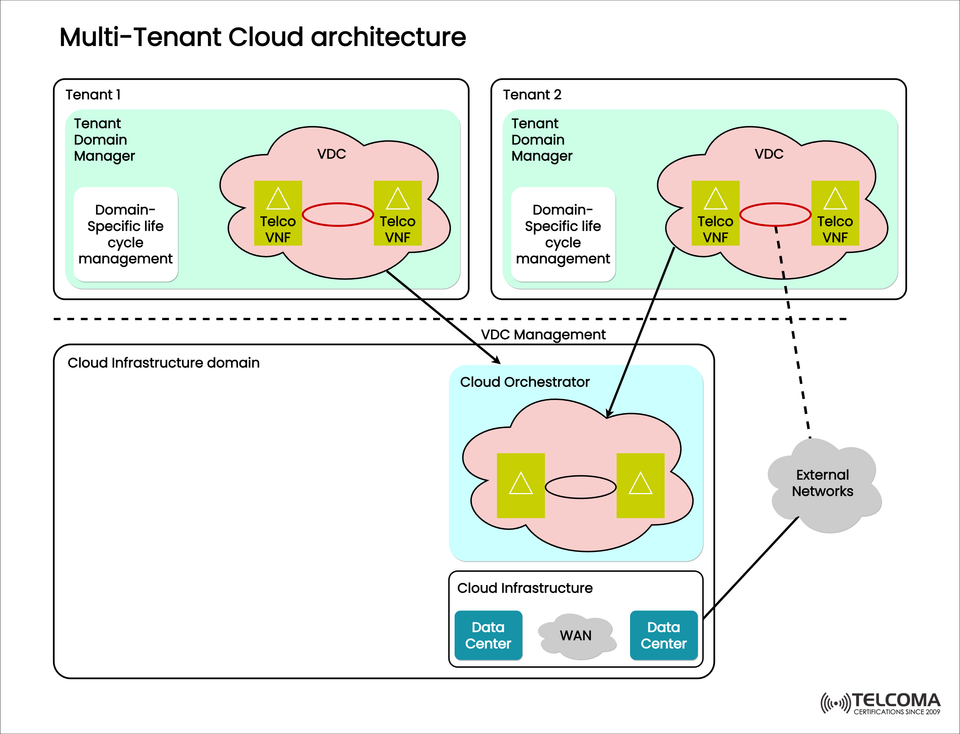
The diagram included highlights this architecture nicely, depicting how Telco VNFs exist alongside different tenant domains, all managed through a collective cloud management layer.
What Is Multi-Tenant Cloud Architecture?
In cloud computing, multi-tenancy means that several users (tenants) utilize the same infrastructure but operate in distinct logical environments.
In the telecom world, this idea extends to multi-tenant NFV and cloud-native networks, where several operators or service domains run Virtual Network Functions (VNFs) on shared data center resources.
Every tenant functions within a Virtual Data Center (VDC), overseeing its own VNFs and lifecycle processes — independently from others.
A. Tenant Domain
Each tenant, shown in the diagram as Tenant 1 and Tenant 2, operates within its own isolated environment.
Tenant Domain Manager
Serves as a controller for the tenant’s cloud resources.
Takes care of domain-specific lifecycle management (like instantiation, scaling, and shutting down VNFs).
Ensures that policies and configurations are consistently applied throughout the VDC.
Virtual Data Center (VDC)
Represents a virtual logical boundary for the tenant within the shared cloud.
Each VDC accommodates one or more Telco VNFs, which can include EPC components, IMS functions, or elements of the 5G core.
VDCs enforce strict resource isolation, meaning one tenant’s VDC won’t disrupt another’s.
Domain-Specific Lifecycle Management
Each tenant has the ability to:
Deploy or scale VNFs based on real-time demands.
Set up automated software upgrades and enforce policies.
Keep an eye on performance and resource usage.
Essentially, each tenant acts like a mini cloud operator within the broader shared infrastructure.
B. Cloud Infrastructure Domain
This domain serves as the foundational physical and virtual support for all tenant environments.
- Cloud Orchestrator
Sits at the center of this infrastructure domain.
Manages VDC creation, allocation, and lifecycle orchestration for multiple tenants.
Engages with NFV Orchestrators (NFVOs) and VIMs (Virtualized Infrastructure Managers) to deploy VNFs in tenant VDCs.
Oversees network slicing, making sure each tenant’s slice gets the required performance levels (QoS, latency, and bandwidth).
- Cloud Infrastructure
Comprises several data centers linked through a WAN (Wide Area Network).
Offers compute, storage, and network resources to host all tenant VDCs.
Includes both virtual and physical network elements (like switches, routers, and storage arrays).
- Connectivity to External Networks
The infrastructure connects securely to external networks, such as the public internet, corporate VPNs, or inter-operator links.
Traffic isolation and various security policies help protect data across tenants.
How Multi-Tenant Cloud Architecture Works
The way tenants interact with the cloud infrastructure follows a structured management model, as shown in the diagram.
Step 1: VDC Provisioning
When a new tenant comes on board, the Cloud Orchestrator assigns a VDC within the shared infrastructure.
The orchestrator sets up compute, storage, and network resources according to the Service-Level Agreement (SLA).
Step 2: Tenant Lifecycle Management
Each tenant utilizes its Tenant Domain Manager to:
Deploy and configure Telco VNFs (like IMS, EPC, or 5G Core components).
Carry out software upgrades and scaling.
Implement security and performance policies specific to their domain.
Step 3: Infrastructure Coordination
The Cloud Orchestrator keeps tabs on resource usage across all VDCs.
It balances workloads dynamically to ensure that no tenant goes beyond its allocated resources, maintaining isolation and fairness.
Step 4: External Connectivity
VNFs within each tenant’s VDC can connect to:
Other VDCs (for multi-domain service chaining).
External networks (for delivering services to customers or peering partners).
Key Features and Benefits
This architectural design offers a flexible and efficient telecom cloud.
A. Tenant Isolation
Each tenant’s resources and VNFs operate fully independently.
Issues or misconfigurations in one tenant won’t impact the others.
B. Resource Efficiency
The shared infrastructure allows for optimal utilization of hardware resources.
Operators can scale their operations without needing to invest in dedicated hardware.
C. Lifecycle Automation
Orchestrators and domain managers take care of VNF lifecycle tasks — from deployment to retirement.
This approach cuts down on manual configurations and operational costs.
D. Scalability
Supports the dynamic addition of new tenants or VNFs with little disruption.
Allows for elastic scaling during high network demand.
E. Security and Compliance
Multi-layered access control, encryption, and network isolation serve to safeguard tenant data.
Aligns with telecom-grade compliance standards (3GPP, ETSI NFV, ISO 27001).
Real-World Applications in Telecom
Multi-tenant architectures are essential in several telecom scenarios:
- Network Slicing in 5G
Each tenant’s VDC can function as a network slice — a specific logical network serving a particular customer, enterprise, or service type (eMBB, URLLC, mMTC).
- MVNO Enablement
Mobile Virtual Network Operators (MVNOs) can manage their own virtualized core and service functions using isolated VDCs from the main operator’s cloud.
- Private Enterprise Networks
Enterprises utilizing 5G private networks can run their VNFs on the operator’s shared cloud while keeping complete control and isolation.
- Edge and Distributed Cloud
This framework can also apply to edge data centers, facilitating multi-tenant edge computing for low-latency applications like IoT, AR/VR, and autonomous systems.
Architecture Comparison Table
Feature Single-Tenant Cloud Multi-Tenant Cloud
Resource Sharing Dedicated Shared
Cost Efficiency High CapEx Reduced CapEx
Tenant Isolation Full (by design) Logical isolation
Scalability Limited to tenant’s capacity Elastic across tenants
Management Complexity Low Moderate to High
Use Case Private enterprise Telecom operators, MVNOs, 5G slices
Orchestration and Lifecycle Management Layers
In a telecom multi-tenant setup, orchestration takes place across two main planes:
Tenant Plane:
Managed by Tenant Domain Managers.
Oversees VNF-level operations specific to each tenant.
Infrastructure Plane:
Controlled by the Cloud Orchestrator.
Handles infrastructure-wide tasks (VDC creation, capacity optimization, and SLA monitoring).
This layered management offers autonomy for tenants while maintaining control for operators — striking the right balance between flexibility and governance.
Integration with NFV and Cloud-Native Technologies
Modern telecom networks are increasingly blending VNFs (Virtual Network Functions) with CNFs (Cloud-Native Functions) in the same multi-tenant cloud.
VNFs run on virtual machines, often based on legacy IMS or EPC components.
CNFs operate in containers (Kubernetes-based), providing greater elasticity.
Hence, the cloud orchestrator needs to support hybrid management, seamlessly integrating both VMs and containers within tenant VDCs.
Benefits for Telecom Operators
By adopting a multi-tenant cloud architecture, operators can:
Host various service providers or enterprise networks on a single platform.
Roll out new services more quickly through automated VNF/CNF deployment.
Lower infrastructure costs through shared resource pools.
Enhance security and compliance with controlled tenant isolation.
Streamline operations via centralized orchestration and monitoring.
Conclusion
The Multi-Tenant Cloud Architecture is a fundamental element of contemporary telecom network design.
By allowing various tenants — including operators, MVNOs, and enterprises — to utilize a common infrastructure domain while retaining independent control and lifecycle management, this model delivers scalability, flexibility, and cost efficiency.
With integrated orchestration, lifecycle automation, and secure VDC isolation, telecom operators can establish truly cloud-native ecosystems capable of supporting diverse 5G, IoT, and enterprise applications.
In short, multi-tenancy is key to the next-generation telecom cloud — merging agility with reliability in an ever-connected world.