
NR-ARFCN Explained: Understanding 5G Frequency Raster and Global ARFCN Parameters
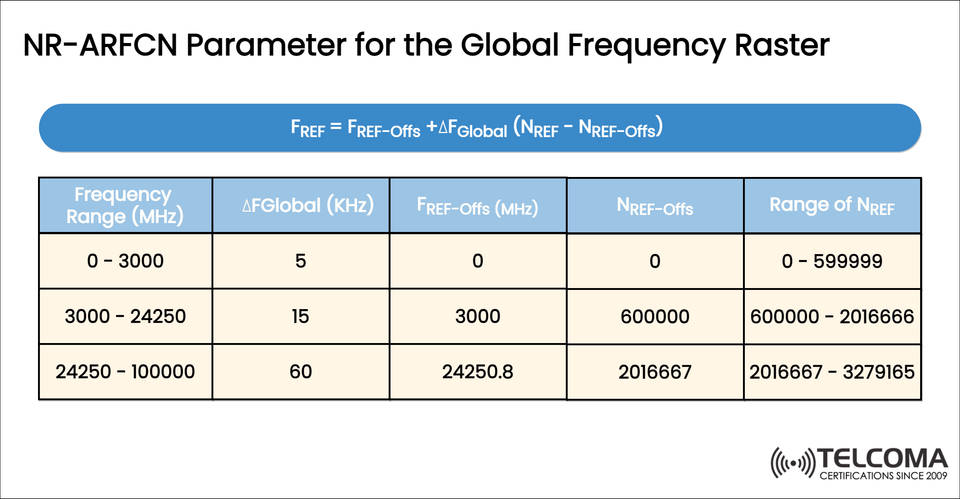

NR-ARFCN Parameter for the Global Frequency Raster: Complete 5G Guide
In 5G New Radio (NR), having an accurate inflection for a frequency is critical for establishing whether devices and networks communicate correctly across the globe. This is where NR-ARFCN (Absolute Radio Frequency Channel Number) comes into play.
The image uploaded, “NR-ARFCN Parameter for the Global Frequency Raster,” depicts how 3GPP describes the global frequency raster - a common reference for determining ARFCNs to the carriers that comprise the totality of the 5G spectrum.
Let's get into what NR-ARFCN is, how it is calculated, and why it is important to 5G networks design and devices tuning.
What is NR-ARFCN in 5G NR?
NR-ARFCN means new radio absolute radio frequency channel number. This means that it is unique number scheme that represents a specific carrier frequency in the new 5G NR spectrum.
Significance of NR-ARFCN in 5G Technology
5G utilizes a wide frequency range consisting of anything below 1 GHz (to provide wide coverage) all the way to 100 GHz (to provide ultra-high throughput). Managing such a wide frequency span requires some degree of common reference system globally, which is exactly what NR-ARFCN provides.
The main purposes of NR-ARFCN include:
Provides a standardized frequency reference system globally for all 5G devices.
Allows for network interoperability across countries and bands much easier than previous wireless technologies.
Allows for various applications to identify exact carrier frequencies for RF planning and testing purposes.
Allows for real-time dynamic spectrum allocation across FR1 or FR2.
Interpreting Global Frequency Raster
The global frequency raster defines how NR-ARFCNs map to a reference frequency (FREF). The global frequency raster is based on parameters established in 3GPP TS 38.104; therefore, every possible frequency could be determined based on using the single formula (as illustrated below).
The formula for reference is:
𝑭𝑹𝑬𝑭
=𝑭𝑅𝑬𝑭−𝑂𝒇𝑓
+𝚫𝑭𝒢𝒍𝒐𝑏𝒂𝒍×(𝑁𝑅𝐸𝐹−𝑁𝑅𝐸𝐹−𝑂𝒇𝒇)
Where
Parameter Definition
FR𝐸F Reference frequency, in MHz.
FREF-Offs Reference frequency offset, for NR-ARFCN range, in MHz.
ΔFGlobal Global frequency raster step size, in kHz.
NREF NR-ARFCN.
An Example of an NR-ARFCN Calculation
Now let's calculate an example ARFCN based on a given 5G carrier frequency.
Example:
Let's find the NR-ARFCN for f = 3500 MHz (3.5 GHz).
Since 3500 MHz is in the range of 3000 - 24250 MHz, we use:
ΔFGlobal = 15 kHz
FREF-Offs = 3000 MHz
NREF-Offs = 600000
Now plug in the values into the formula:
3500 = 3000 + 0.015×(NREF - 600000)
500 = 0.015×(NREF - 600000)
NREF - 600000 = 500/0.015 = 33333.33
NREF = 633333.33
✅ Result: NR-ARFCN = 633333 at 3500 MHz.
This ARFCN uniquely identifies the 3.5 GHz frequency within the overall global 5G system.
Mapping NR-ARFCN to Frequency Bands
5G NR Band Frequency Range (MHz) Typical ARFCN Range Region / Usage
n1 2110 – 2170 ~422000 – 433000 Europe, LTE Refarming
n3 1805 – 1880 ~361000 – 376000 Global LTE Band
n78 3300 – 3800 ~620000 – 666000 Global mid-band 5G
n258 24250 – 27500 ~2016667 – 2076667 mmWave 26 GHz
n260 37000 – 40000 ~2160000 – 2200000 mmWave 39 GHz
This sort of mapping allows equipment vendors and operators to ensure that their RF hardware, band filters and antennas are all correctly aligned to 3GPP specifications.
- Backward Compatibility
Builds upon established LTE (EARFCN) concepts, enabling simple movement from 4G to 5G networks.
- Efficient Spectrum Management
Now operators can change frequencies and bandwidth allocations during the any service requests while still keeping the ARFCN index consistent.
- Multi-band and Multi-RAT Coexistence
In addition, will allow for carrier aggregation and inter-operability among NR, LTE and previous systems.
Practical Usage Cases of NR-ARFCN
RF Planning: Allocating frequency, Controlling interference, and mapping 5G Band
UE Testing: Tuning and validation of devices in FR1 and FR2 bands
Network Optimization: Dynamic spectrum sharing (DSS) and inter-band CA.
Spectrum Regulation: Ensuring that national regulator maps their designated 5G frequency ranges directly to ARFCN standards.
Challenges and Considerations
Although potentially simple, engineers face the following downsides:
High ARFCN resolution in the mmWave bands (FR2)
Device limitations - Not all modems can support ARFCN all ARFCNs
Out of sync devices, due to DSS
Mapping errors of software tools for network configuration, in the formulas the parameters mismatch
Making sure it aligns "exactly" with3GPP TS 38.104 table data and band definitions will provided reliable results.
Future of NR-ARFCN and 6G Development
With the expansion of 5G, the concept of NR-ARFCN will be even more valuable in effectively managing increasingly difficult frequency environments. In combination with Dynamic Spectrum Sharing (DSS) and Network Slicing, having accurate frequency references becomes important for performance and for minimizing interference.
Expanded Frequency Ranges
Future releases of 3GPP (e.g., Release 18 and beyond) plan to add sub-THz (frequency>100 GHz) to the capabilities for 6G. This will likely prompt:
New ΔFGlobal step values in individual numercial format to allow for greater precision.
Updated NREF ranges based on the new spectrum and segments of frequency.
Enhanced frequency offsets parameters (i.e., FREF-Offs) needed for ultra-wide bandwidths.
Intelligent Spectrum Management
AI-Driven network controllers will leverage the ARFCN-based map to assign frequencies dynamically:
According to the traffic load.
According to the real-time analysis of interference.
According to beamforming proximity distance on FR2 bands.
While it sounds complicated, the needed level of automation would be managed by a reliable and consistent ARFCN numbering system, allowing efficient and smooth transition frequency management between frequency layers and usage technologies.
Global Device Interoperability
As operators deploy multi-band 5G NR, device manufacturers are highly dependent on NR-ARFCN harmonization across borders. A single device chipset may support dozens of bands of operation, but it ultimately accomplishes this use through use of the NR-ARFCN map and identification.
Conclusion
Simply put, by using the NR-ARFCN for the Global Frequency Raster, you now have the mathematical backbone for 5G's global frequency coordination. By linking MHz frequencies to an ARFCN index it allows your devices to accurately tune all bands and allowing and effective spectrum sharing (DSS) that can be beneficial in the following cases -all those bands, low-band FR1, etc.