
NR-ARFCN Per Operating Band (FR2 > 6GHz): Complete Guide to 5G mm Wave Frequency Allocation

Understanding NR-ARFCN Per Operating Band (FR2 > 6GHz)
The 5G New Radio (NR) frequency landscape is split into two main ranges — FR1 (Sub-6GHz) and FR2 (mm Wave). FR1 is all about coverage and capacity, whereas FR2 (Frequency Range 2) operates above 6GHz to deliver ultra-high throughput and super low latency.
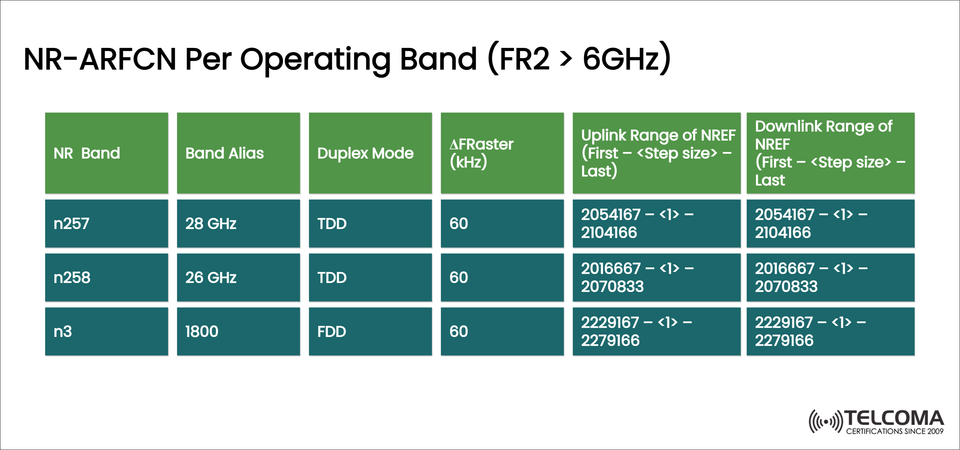
In this blog, we’ll dig into NR-ARFCN per operating band in FR2 (>6GHz), as shown in the table we uploaded. We'll look at bands n257, n258, and n3, their duplex modes, and how frequency allocation relates to ARFCN spacing.
What is NR-ARFCN?
NR-ARFCN (New Radio Absolute Radio Frequency Channel Number) is basically a unique ID for a specific 5G carrier frequency.
It’s important because:
It links directly to the carrier’s center frequency.
It helps make tuning and configuration easier for both base stations and user equipment (UE).
It ensures different vendors and network components can work together smoothly.
The way NR-ARFCN relates to the frequency is explained in 3GPP TS 38.104. You can use this formula to find the center frequency (Fref) in MHz:
Fref = FGlobal ext{_}offset + (NREF × ΔFRaster)
Where:
FGlobal ext{_}offset is the reference frequency offset.
NREF is the NR-ARFCN number.
ΔFRaster is the frequency raster (or step size).
Overview of FR2 Frequency Range
FR2 (Frequency Range 2) covers spectrum bands from 24.25 GHz to 52.6 GHz. These bands are also known as mm Wave bands and are crafted to deliver:
Multi-Gbps data rates
High bandwidth capacity
Ultra-low latency
Dense small-cell setups
But, because of the higher frequency and shorter wavelengths, FR2 signals don’t cover as much area and struggle with penetration, which means they need careful planning and a lot of base stations.
NR-ARFCN Per Operating Band (FR2 > 6GHz)
The image shows the following FR2 operating bands:
NR Band | Band Alias | Duplex Mode | ΔF Raster (kHz) | Uplink Range of NREF | Downlink Range of NREF
n257 | 28 GHz | TDD | 60 | 2054167 – <1> – 2104166 | 2054167 – <1> – 2104166
n258 | 26 GHz | TDD | 60 | 2016667 – <1> – 2070833 | 2016667 – <1> – 2070833
n3 | 1800 MHz | FDD | 60 | 2229167 – <1> – 2279166 | 2229167 – <1> – 2279166
Key Parameters Explained
- Duplex Mode (TDD vs FDD)
TDD (Time Division Duplex):
Used in mmWave bands (n257, n258).
Uplink and downlink share the same frequency split by time slots.
Gives flexibility in resource allocation based on traffic demands.
FDD (Frequency Division Duplex):
Used in sub-6GHz bands, like n3.
Separate frequencies are used for uplink and downlink.
Allows for simultaneous sending and receiving.
- Frequency Raster (ΔF Raster)
ΔF Raster is the frequency step size in kHz for calculating the ARFCN.
In FR2 bands, the raster is usually 60 kHz, which comes from a 15 kHz subcarrier spacing multiplied by a scaling factor of 4 — matching 5G NR’s scalable numerology.
This step size helps ensure:
Efficient spectrum use
Easier frequency planning
Compatibility across different hardware setups
- Uplink and Downlink Ranges
The table breaks down the uplink and downlink ranges for NREF (Reference NR-ARFCN) values.
For TDD bands (n257, n258), the uplink and downlink ranges are the same because the frequency is shared by time.
In FDD bands (like n3), the ranges differ since uplink and downlink occur at the same time on different frequencies.
For example:
n257 (28 GHz) runs from 2054167 to 2104166 for both uplink and downlink.
n258 (26 GHz) covers 2016667 to 2070833, which is a bit lower on the mmWave scale.
n3 (1800 MHz) keeps supporting FDD, bridging the gap between FR1 and FR2 spectrum planning.
Detailed Look at FR2 Bands
Band n257 (28 GHz)
Frequency Range: 26.5 GHz – 29.5 GHz
Duplex Mode: TDD
ARFCN Range: 2054167 – 2104166
Bandwidth Capacity: Up to 400 MHz
This band is heavily used in North America and parts of Asia for commercial 5G rollouts.
Its wide bandwidth allows for ultra-fast data transfers, making it perfect for:
Fixed Wireless Access (FWA)
High-density urban setups
5G backhaul connectivity
Band n258 (26 GHz)
Frequency Range: 24.25 GHz – 27.5 GHz
Duplex Mode: TDD
ARFCN Range: 2016667 – 2070833
Bandwidth Capacity: Up to 400 MHz
The n258 band is more universally accepted compared to n257, with a strong presence in Europe, Australia, and Asia.
It's often used for:
Enhanced Mobile Broadband (eMBB)
Private 5G networks
Industrial automation that needs high throughput
Band n3 (1800 MHz)
Frequency Range: 1710 – 1880 MHz
Duplex Mode: FDD
ARFCN Range: 2229167 – 2279166
While usually grouped under FR1, n3 shows up here to highlight backward compatibility and spectrum re-farming — letting 4G LTE bands coexist with 5G NR through Dynamic Spectrum Sharing (DSS).
Why FR2 Matters in 5G Evolution
FR2 bands, despite their shorter range, are crucial for achieving 5G’s goal of multi-gigabit speeds. They provide:
Massive bandwidth: Allowing for 400 MHz or more per carrier.
Low latency: Critical for things like AR/VR, self-driving cars, and remote surgeries.
High spectrum reuse: Great for dense urban deployments.
But, there are challenges, too:
Poor indoor penetration
Need for line-of-sight
Higher power usage
To tackle these issues, operators employ beamforming, massive MIMO, and hybrid FR1+FR2 setups.
Comparing FR1 and FR2 ARFCN Characteristics
**FeatureFR1 (<6GHz)FR2 (>6GHz)**Frequency Range410 MHz – 7125 MHz24.25 GHz – 52.6 GHz and width Up to 100 MHz Up to 400 MHz Duplex Mode FDD / TDDTDD Coverage Wide Limited Capacity Moderate Very High Use Cases Coverage, mobility Hotspots, eMBB, FWA
Conclusion
The NR-ARFCN per operating band in FR2 (>6GHz) is key to grasping how 5G mm Wave networks manage spectrum resources. Bands like n257 (28 GHz) and n258 (26 GHz) are driving the next generation of applications that require ultra-high throughput and minimal latency, while n3 shows how 5G can work alongside existing LTE setups.
As the 5G ecosystem continues to grow, understanding concepts like NR-ARFCN, duplex modes, and frequency rastering becomes essential for telecom professionals looking to design, optimize, or manage advanced 5G networks.