
PCI Collision and PCI Reuse Distance in 5G NR Explained

Introduction: Why PCI Planning Matters in 5G
In 5G NR (New Radio), the Physical Cell ID (PCI) is essential for identifying cells, syncing, and managing mobility. There are 1008 unique PCIs, and each cell in a network needs one assigned so that user equipment (UE) can reliably detect and connect.
But in crowded networks with small cells and overlapping coverage, poor PCI assignment can lead to problems like PCI Collision and PCI Confusion, which can seriously impact the user experience. That’s why understanding PCI reuse distance and careful planning is so important for telecom engineers.
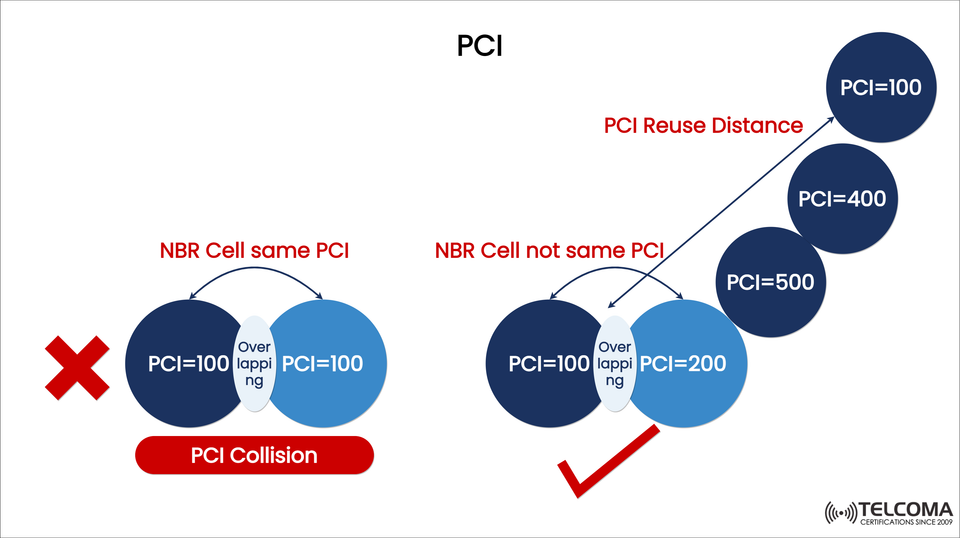
Take a look at the image:
On the left, you can see overlapping cells assigned the same PCI causing PCI collision.
On the right, various PCIs with proper reuse distances avoid these conflicts.
What is PCI Collision?
PCI Collision happens when two or more neighboring or overlapping cells get assigned the same PCI.
Why Does This Occur?
The limited PCI pool in dense deployments.
Subpar network planning or improper SON (Self-Organizing Network) setup.
Effects of PCI Collision:
Confusion for the UE: The device struggles to tell which cell it should connect to.
Handover failures: Moving between cells can drop calls or fail entirely.
Sync issues: The UE may get misaligned with the wrong cell.
Degraded service: This can cause interference, call drops, or reduced throughput.
Example:
If two adjacent cells are both set to PCI = 100, and their coverage overlaps, the UE might not know which one to connect to.
What is PCI Confusion?
Though not shown directly in the image, PCI confusion is another issue in planning. It occurs when:
A UE spots two different neighboring cells using the same PCI but coming from distinct geographical directions.
Even if the cells don’t completely overlap, there’s still ambiguity.
Impact: Much like PCI collision, PCI confusion complicates handover management and can destabilize the network.
PCI Reuse Distance: The Key to Efficient PCI Planning
Given that the PCI range is limited (0–1007), PCI reuse is unavoidable in larger networks. Yet, this reuse needs to be strategically planned to sidestep collisions.
Definition:
PCI Reuse Distance refers to the minimum physical distance between two cells using the same PCI, ensuring their coverage areas don’t overlap or interfere.
In the Diagram:
Wrong Case (Left): PCI = 100 is used in two overlapping cells → collision.
Correct Case (Right): PCI = 100 is reused, but only after enough distance to prevent overlap. Other cells use PCI = 200, PCI = 400, PCI = 500, ensuring clear separation.
Benefits of Proper PCI Reuse:
Reduces interference.
Supports scalable network growth.
Allows smooth handovers.
Optimizes spectrum use.
PCI Planning Strategies in 5G Networks
- Manual PCI Planning
Engineers assign PCIs to cells based on the network layout.
Good for smaller networks or critical coverage areas.
Drawback: Can take a lot of time in larger setups.
- Automatic PCI Assignment (SON)
Uses Self-Organizing Networks to dynamically allocate PCIs.
Adapts automatically to new cells (especially useful for small cells).
Needs careful setup to avoid constant reassignments.
- Hybrid Planning
Manual assignment for essential cells.
SON automation for managing high-density small cells.
PCI Allocation Rules for Engineers
To avoid PCI collision and confusion, engineers follow these guidelines:
No PCI Collision: Neighboring cells shouldn’t share the same PCI.
Avoid PCI Confusion: Neighboring cells need distinct PCIs from adjacent third cells.
Keep PCI Reuse Distance: Reuse a PCI only after enough geographical separation.
Prioritize Interference Zones: Assign unique PCIs in crowded or overlapping areas.
Utilize PCI Groups Wisely: With 336 PCI groups × 3 identities, group-based allocation simplifies things.
PCI Reuse in Dense Urban 5G Networks
With the rollout of small cells, massive MIMO, and mmWave deployments, PCI planning gets trickier:
Urban small cells: Hundreds of cells packed into a square kilometer need careful PCI reuse.
Beam-based synchronization: PCIs connect to beams, which complicates detection more than in LTE.
High mobility scenarios: The risk of handover failures rises with PCI collisions.
Example:
In a smart city setup:
Macro cell: PCI = 100
Nearby small cells: PCI = 200, 201, 202
Another macro cell three kilometers away: PCI = 100 (which is a safe reuse distance).
This setup helps ensure that UEs can handover seamlessly without misjudging PCIs.
PCI Collision vs PCI Reuse Distance (Quick Comparison)
Aspect PCI Collision (Bad)PCI Reuse Distance (Good)Condition Same PCI in overlapping cells Same PCI reused after enough distance Result for UE Confusion, failed handovers, drops Clear cell identity, smooth mobility Impact on Network Interference, poor QoS Efficient PCI use, scalable network design Example from Image Two cells with PCI = 100 overlapping Cells with PCI = 100, 200, 400, 500 separated
Challenges in PCI Planning
Limited PCI Range: Only 1008 PCIs available for dense 5G setups.
High Cell Density: Small cells and IoT devices increase PCI reuse challenges.
Beamforming Complexity: Sync signals are beam-based instead of sector-based.
Dynamic Deployments: SON might frequently reassign PCIs, risking network instability.
Best Practices for PCI Management in 5G
Conduct regular PCI audits to catch collisions and confusion.
Utilize planning software tools for better allocation.
Apply SON cautiously, with safeguards for stability.
Combine frequency planning and PCI planning to reduce interference.
Train field engineers to identify PCI-related mobility issues.
Conclusion: PCI Reuse Done Right
In 5G NR, PCI collision and PCI confusion can lead to major network performance issues if not managed properly. The key is in planning PCI reuse distance, which ensures that the same PCI is only reused where it won’t overlap or create interference.
For telecom professionals, mastering PCI allocation is vital for:
Smooth handovers.
Improved Quality of Service (QoS).
Effective large-scale 5G deployments.
Simply put:
PCI collision disrupts networks, while PCI reuse distance strengthens them.