
Service-Based Architecture for Autonomic Networking in 5G: A Deep Dive
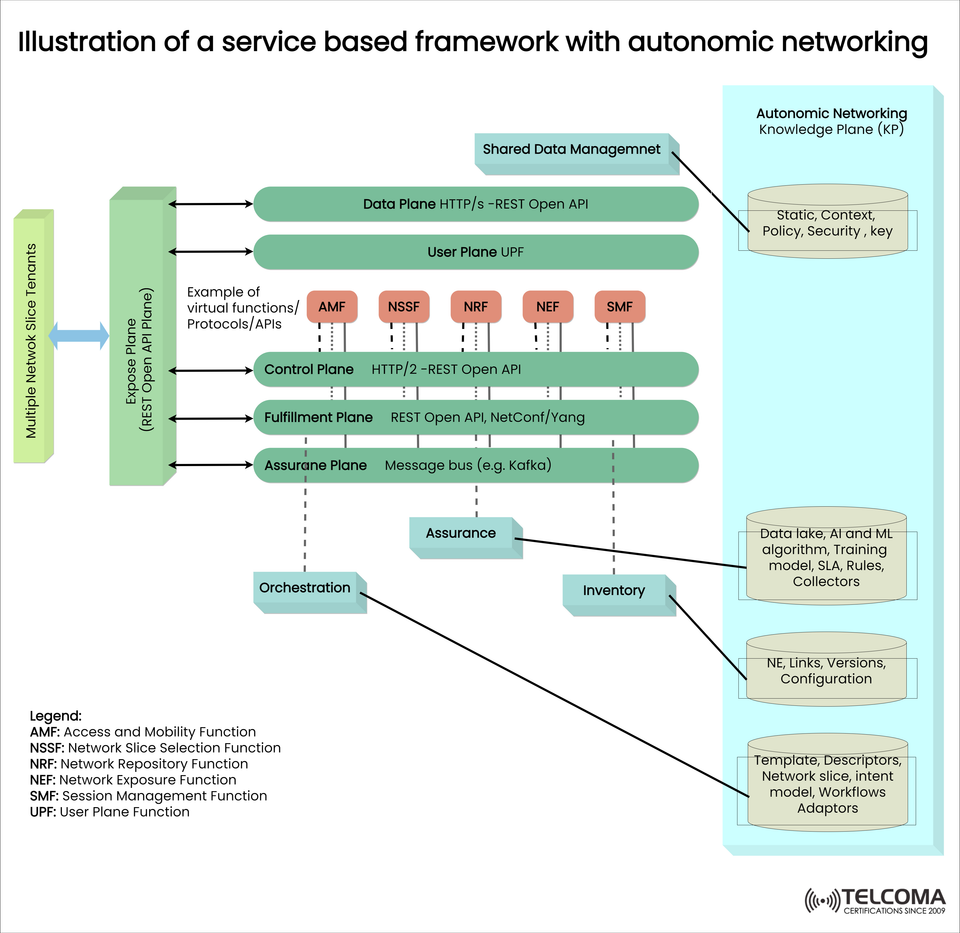

The image depicts a tightly-coupled, modular multi-plane system using open RESTful APIs with autonomic layers. Let’s breakdown what the elements of this framework would be.
- Exposure Plane (REST Open API)
- Interfaces with multiple network slice tenants
- RESTful API forms of communication between multiple network functions and users
- Provides a slice-based service exposure point with secure and scalable features
- Network Functions Planes
Plane Technology Stack Use
Data Plane HTTP/s REST Open API transports data between core functions and user plane (UPF)
User Plane (UPF) — Handles user data traffic: tied SMF and external data interfaces
Control Plane HTTP/2 REST Open API Monitors AMF, SMF, NRF, NEF, NSSF and plans for network slices.
- Virtual Network Functions (VNFs)
AMF: Access and Mobility Management
SMF: Session Management
NSSF: Slice Selection
NRF: Function Discovery
NEF: External Exposure and Control
Each of these modules are independently callable using open APIs and wrapped into the autonomic assurance and orchestrator systems.
- Autonomic Networking – Knowledge Plane (KP)
The KP is a key enabler for self-directed networks to categorize attributes across all planes based on:
- Shared Data Management - consisting of context, policies, keys, and static state
- AI/ML algorithms for ongoing analysis and proactive decisions
- Centralized repositories - Data Lakes for telemetry, configuration data, and intelligent models
- Service Templates and Intents to orchestrate at a higher level using business logic
The KP will be the foundational plane that allows closed-loop operations with intent-based networking capability.
Core Capabilities Enabled by the Architecture
✅ Intent-Based Networking (IBN)
Templates and policies to guide the system to autonomously comply with service level intents.
✅ Dynamic Orchestration
Real-time updates and scaling of network slices via modular workflow and adaptors.
✅ Assurance & Analytics
Kernel based message buses via Kafka to capture events which are fed into ML engines for predictive analytics.
✅ Inventory Management
Tracks the NE versions, configurations, the topology, and links for service compliance.
✅ Slicing as a Service
Operators are able to expose and manage network slices dynamically for multiple tenants.
Advantages to Telecom Operators and CSPs
Lower Operational Overhead: Via automation and self-managing
Accelerated Service Delivery: With open APIs and cloud-native orchestration
Better Time to SLA: With proactive assurance and adaptive fulfillment
Vendor Interoperability: Via REST APIs and abstraction of different protocols
Future Ready: Designed for 6G and beyond with AI scaling-up
Conclusion:
Toward Self-Managing Networks
The service-based framework described above is a blueprint for autonomic 5G networking. The service-based framework helps telecom operators achieve zero-touch provisioning, closed-loop assurance, and resource allocation flexibility and reliability.
As 5G networks become more complex with IoT, edge computing, and private networks, being able to leverage intelligent and open framework architectures will be important for remaining competitive as digital markets are rapidly transformed.
Examples of Application of the Service-Based framework
📶 Private 5G. Organizations can deploy private 5G using dynamic resource slicing. This will allow specific enterprise functions (e.g., factory automation, remote surgery) to reserve bandwidth and latency.
⚙️ Network-as-a-Service (NaaS). Since the exposure plane exposes REST APIs, telecoms can monetize their network functons by allowing third parties to consume their network functions and applications; thus verticals like automotive, healthcare, and logistics industry can have network slices dynamically as needed.
🧠 Closed-Loop Automation
The assurance plane finds SLA violations or drops in performance and creates the ticket to an orchestration workflow to remediate the situation using AI/ML algorithms without human intervention.
Key Technologies
Technology/Protocol Role
REST/HTTP/HTTP2 led by APIs to expose and interact with services
Kafka or Message Bus Provides real-time telemetry and assurance feedback loop
NetConf/YANG Provides a model for configuration and fulfillment
AI/ML Algorithms provide belief or certainty to make decisions, recognize patterns, and self-optimize
Data Lakes acts as central repository for analytics
Industry Standards
This is aligned with some of the industry’s best efforts, including:
3GPP: Service-based architecture for 5G Core, and where the notion of SBA came from
ETSI ZSM: Zero-touch network and service management
TM Forum: Open APIs and intent-based management
ONAP: Framework for orchestration and automation
Following standards provides assurance that the architecture is interoperable and forward-looking.
Issues
Some of the substantial benefits aside, the willingness to either move to this kind of architecture is not small, and there are many issues to consider:
Integration of Legacy Networks: Existing investments in the network need to have some ways to work with today’s APIs
Security Governance: The assurance and orchestrate plans will need some serious security mechanisms to avoid misuse
Cultural Want: The operational team people’s desire to completely willy nilly about the automation decision.
Problem Associated with Vendor lock-in: Make sure to choose a vendor who is not going to sell you packaged goods and supports open APIs and standard data models.
Final Thoughts:
Envisioning an Autonomous Future
The proposed service-based autonomic networking framework is more than vague wishful thinking. It can be a very realistic and practical pathway to an autonomous future. As telecom networks become more predominantly software-defined and cloud-native, service-based use and modular approaches to autonomy can provide the capabilities that enable dynamic, intelligent, and policy-driven operations.
By embracing the full potential of the entire control, fulfillment, assurance, and knowledge planes, telecom and other stakeholders can significantly reduce system complexity, embrace innovation, and deliver unmatched service agility in the rapidly evolving 5G landscape.
✅ Concrete Next Steps for Telecom Professionals:
Assess current APIs and readiness for automation
Begin to incorporate a messaging bus (Kafka) for real-time assurance
Plan for workflows with open data models (YANG, NetConf)
Implement AI/ML to drive assurance and orchestration loops
Plan for guideline-based models to simplify service deployments
Looking for help with implementing such frameworks or planning your telecom automation roadmap?
Engage a network automation specialist or explore ONAP, O-RAN, and ETSI NFV open-source tooling and reference solutions.