
Signal Strength in Cellular Networks: Understanding Strong vs Weak Signal Coverage Zones
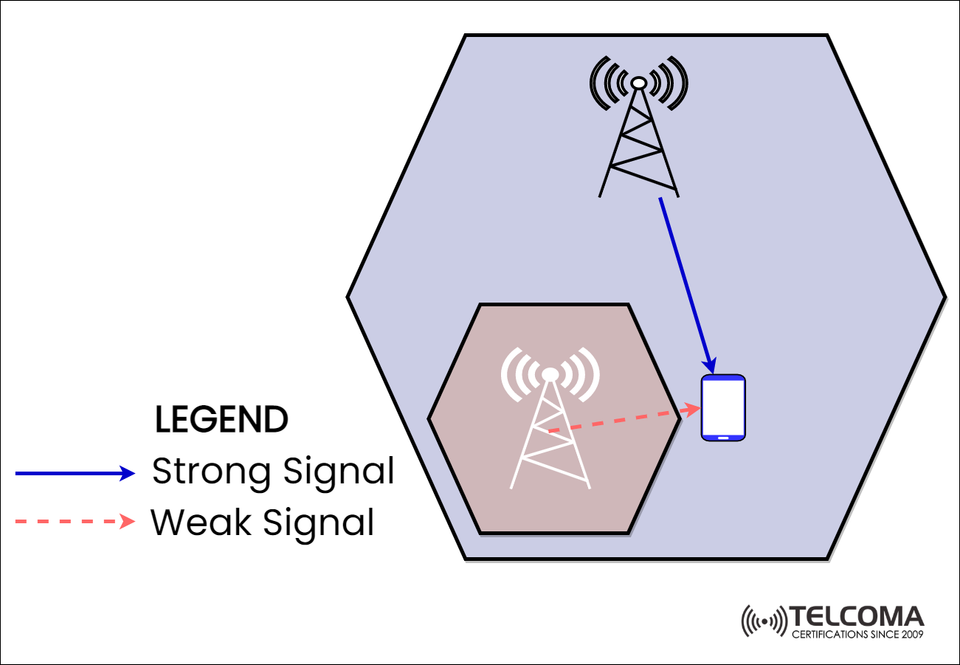

Signal Strength Zones in Cellular Network Contexts: Strong Coverage vs Weak Coverage
Signal strength is a critical component of the user experience in modern cellular networks. It may be demonstrated by a dropped call, slow data speeds, or super-fast 5G— ultimately, it all depends on the quality of the signal between your mobile device and the closest base station.
The posted image below demonstrates the differences between strong and weak signal zones in a multi-cell environment. In this blog, we will further outline the factors that affect signal strength and why optimizing coverage zones is critical for the provider and for the user.
📡 What does the image illustrate?
This image provided demonstrates hexagonal cellular coverage— this is usually used for visualizing a cell site or network's ideal coverage areas. The image illustrates:
One mobile device receiving a strong signal (solid blue arrow) from one base station.
The same mobile device receiving a weak signal (dashed red arrow) from another base station, nearby.
Two cells, the one with strong coverage (blue shaded) and the one with weak coverage (red shaded).
A legend for signal attributes.
This visual example provides clarity on how a mobile device could potentially ignore a closer tower if it provides a weaker signal than the neighboring, stronger signal from a farther away tower.
🛰 Signal Strength Classifications
Signal Strength Description User Experience
Strong Signal Good connection, fast speeds, low latency Clear video calls, fast downloads
Moderate Signal Usable signal, but service degraded May experience buffering, slow download speeds
Weak Signal Poor quality and call drops, timeout for the connection Call failures and little to no connectivity
📶 Strong vs Weak Signal: Real Life Scenarios
✔️ Strong Signal (as shown in the image)
Device is well connected to a base station
Means better throughput and latency
Less battery drain on the device (less retransmission or power boost)
✖️ Weak Signal ( as shown from the second base station)
May drop connections due to handover failures or ping-pong effects
The device may struggle to keep connections when the user is moving, especially in high mobility scenarios
Interference may be higher if the coverage area from the two base stations overlaps
🛠 How Operators Improve Signal Coverage
Operators use several different methods to maintain strong signal coverage:
Cell Splitting: Deploying more base stations in high traffic areas.
Antenna tilting and beamforming: Directionally tilting antennas and focusing where the signal goes
Small cells and repeaters: Improving indoor and area density coverage.
Dynamic spectrum allocation: Use the best frequency that’s available in the environment.
🌐 Use Case: Why a Device prefers to have a Distinct Strong Signal.
In the image, the user equipment (UE) is selecting a base station with a strong signal, even if it is further away. This can be due to:
Radio Resource Control (RRC) algorithms favoring the best quality of signal (RSRP/RSRQ)
Loading balancing policies that want to offload traffic from congested weak cells.
Signal-to-Noise Ratio (SNR) metrics that are also used to determine what serving cell the UE is in or how to decide which serving cell to connect to.
🏁 conclusion
At a minimum, the basics of signal strength should be understood both by telecom's or the average person. If you have a strong signal it means a better experience for the user, if you have a weak signal it causes issues that should be managed with planning from network perspectives based on business objectives.
This illustration describes a major take away, connectivity issues are primarily based on signal strength, not distance. The emergence of 5G and new 6G will make signal optimization and coverage planning essential.
🚦 Signal Strength and Mobility Management.
In the cellular landscape, especially related to 4G and 5G, mobility management plays an important role in maintaining connectivity when the user equipment is traveling between cells.
🔄 Handover Triggering through Signal Strength.
Deciding when to handover (device goes from base station to base station based on whatever metric) is primarily based on:
Reference Signal Received Power (RSRP)
Reference Signal Received Quality (RSRQ)
Signal-to-Interference-plus-Noise Ratio
📡 How Handover Works in the Context of the Scenario (Image Context)
In the image:
The user equipment (UE) can see both towers.
But because the distant tower has a stronger signal, it is the preferred serving cell.
A handover to the closer tower will not happen unless either the nearby tower boosts its signal, or the distant tower’s signal drops considerably.
This mechanism allows for session continuity, and for quality of service (QoS), which is especially useful for 5G scenarios with high data throughput requirements.
📍 Practical Considerations for Network Planning
Operators must carefully study the propagation of signals using RF planning system tools to:
Avoid coverage holes (areas with weak or no signal).
Avoid excessive overlap (which creates interference).
Avoid handover failures and dropped calls.
Maintain QoE (Quality of Experience) at high speeds (in trains, highways).
Tools/techniques used:
Drive testing and walk testing.
Network simulation and propagation models.
Automated tuning with AI/ML (in 5G SON networks).
🧠 Advanced Concepts for Consideration
📶 Carrier Aggregation and Signal Strength
Even in low signal areas care aggregation (CA) can combine multiple frequencies in the same band, improved throughput is possible. But the performance of aggregated cartridges relies heavily upon the signal quality for each original cartridge.
🌐 Beamforming in 5G
5G provides beamforming, where the base station will steer focused signals of propagation to the user plana (UE) rather to the entire coverage area like in 3G and 4G.
🧰Optimization Checklist for Network Engineers
Optimization Task Goal
Adjust antenna tilt/azimuth improve coverage overlap
Implement small cells increase access indoors and in urban areas
Tune handover thresholds avoid ping-pong handovers
Monitor weak signal areas heatmaps and drive tests
Implement SON features allow signals to be re-tuned on the fly
🔮 Looking Ahead: Where to From Here?
As we move into the 6G era with even more complex use cases (such as holographic communications, fumigating remote surgical practices, and fully autonomous vehicles), managing variability of signal strength will become exponentially complicated.