
Sub-array Partition vs. Fully Connected Model in 5G MIMO Beamforming Explained

Sub-array Partition vs. Fully Connected Model in 5G MIMO Systems
The development of 5G networks really hinges on advanced antenna technologies, especially massive MIMO and beamforming. To make the most of these technologies, engineers turn to various antenna array architectures—with the sub-array partition model and the fully connected model being two of the most prominent.
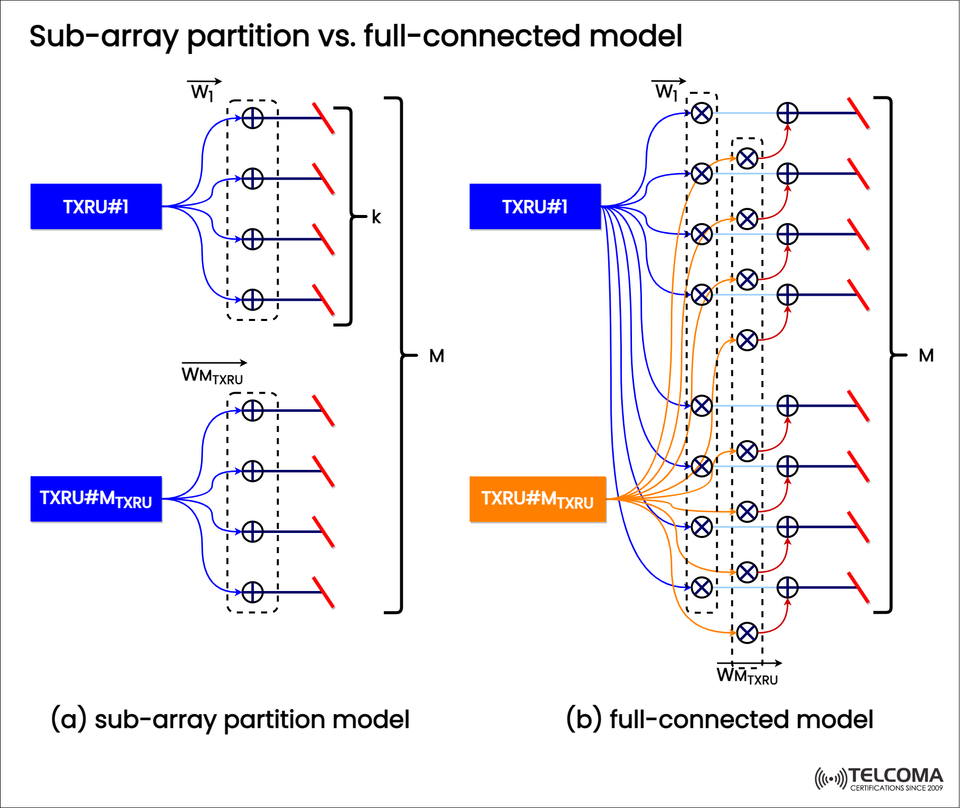
The image shared from Telcoma clearly shows these two setups and how the Transmit-Receive Units (TXRUs) link up with the antenna elements. Grasping their differences is key if we want to optimize beamforming, manage hardware complexity, and boost power efficiency in 5G base stations.
Understanding the Context: MIMO and Beamforming in 5G
Before we dive into the models, let’s recap how MIMO and beamforming function.
MIMO (Multiple Input Multiple Output) utilizes multiple antennas at both the transmitter and receiver ends to enhance data throughput and reliability.
Beamforming aims the signal energy specifically at users or devices, which strengthens the signal while reducing interference.
To implement beamforming, each antenna element receives signals that are adjusted for specific phase and amplitude weights, managed by the beamforming network. The connection method of TXRUs to these antenna elements shapes the architecture: sub-array partition or fully connected.
The Two Models at a Glance
The image illustrates the two configurations:
(a) Sub-array Partition Model (Left)
Each TXRU oversees a subset of antenna elements.
TXRU#1 controls k antenna elements.
TXRU#2 operates another k elements, and so on, up to MTXRU.
This brings the total number of antenna elements to M = k × MTXRU.
In this setup, every TXRU only connects to its designated antennas.
(b) Fully Connected Model (Right)
Every TXRU connects to all antenna elements via a network of phase shifters and power dividers/combiners.
Each antenna element obtains a signal that’s a weighted mix of signals from all TXRUs.
This setup allows for detailed beamforming control and greater flexibility, though it does come with increased hardware complexity.
Deep Dive into Each Model
3.1 Sub-array Partition Model
In the sub-array model, the antenna array gets divided into several smaller sub-arrays, each powered by its own TXRU.
Key Characteristics:
Simpler architecture: Each TXRU is linked to a limited number of elements.
Reduced hardware cost: You don’t need as many phase shifters and combining networks.
Lower power consumption: Works well for compact and energy-saving setups.
Limited beamforming ability: Each sub-array makes its own beam, which means steering isn’t as flexible.
Advantages:
Scalable and cost-effective for mid-band 5G (like 3.5 GHz).
Easier to integrate in massive MIMO arrays with 64 or 128 antenna elements.
A solid balance between performance and complexity.
Disadvantages:
Beamforming isn’t as detailed—beams are wider and less targeted.
Performance can dip in areas needing fine angular resolution.
Each sub-array operates on its own, so multi-user beamforming can be less effective.
3.2 Fully Connected Model
The fully connected model is more intricate but offers greater power. Here, each TXRU hooks up to all antenna elements, and each one gets a combined signal from all TXRUs via phase and amplitude control networks.
Key Characteristics:
Total interconnection: Every TXRU interacts with every antenna element.
High flexibility: Facilitates optimal beamforming and multi-user spatial multiplexing.
Dynamic control: You can adjust beam directions with high precision.
Increased hardware complexity: It needs more phase shifters, combiners, and calibration.
Advantages:
Maximum beamforming gain: You get to finely control amplitude and phase across the entire array.
Better spectral efficiency: Can accommodate more users at once (multi-user MIMO).
Perfect for mmWave frequencies, where tight beams are crucial.
Improved interference management: Strongly directional beams cut down on inter-user interference.
Disadvantages:
Higher implementation costs: Every connection needs analog components (like phase shifters).
Complicated calibration: Keeping phase coherence across all paths is tricky.
More power consumption: More components can lead to greater thermal load and energy expenses.
Mathematical Insight: How the Models Differ
Sub-array Model
Let’s define:
M = total number of antenna elements,
MTXRU = number of TXRUs,
k = rac{M}{MTXRU} (antennas per sub-array),
In this case, each TXRU controls k antennas, using a beamforming vector of size k × 1. The overall beamforming matrix is block-diagonal since each TXRU only influences its designated antennas.
Fully Connected Model
Here, every TXRU contributes to all antenna elements. The beamforming matrix is dense, meaning all entries are filled:
This allows for joint beamforming optimization, resulting in stronger, more focused beams.
Comparison Table: Sub-array vs. Fully Connected Model
Feature Sub-array Partition Model Fully Connected Model Connectivity Each TXRU drives a subset of antennas Each TXRU drives all antennas Beamforming Control Limited (per sub-array)Full (across all elements)Beam width Wider Narrow and precise Complexity Low High Hardware Cost Lower (fewer phase shifters)Higher (more phase shifters)Power Consumption Lower Higher Scalability Easier for massive MIMO Complex to scale beyond moderate sizes Ideal Frequency RangeSub-6 GHz mmWave (24–100 GHz)Use Case Example5G macro cells, mid-band5G small cells, mmWave beamforming
Real-world Implementation in 5G Networks
The sub-array architecture is commonly used in mid-band (C-band) 5G setups, like 64T64R antenna arrays. It strikes a practical balance between hardware costs and beamforming performance.
Fully connected models thrive in mmWave systems (for instance, 28 GHz or 39 GHz bands), where accurate beam precision is necessary to navigate propagation losses.
In massive MIMO base stations, hybrid beamforming often combines both models—using digital precoding at baseband (like a fully connected system) and analog beamforming at the RF stage with sub-arrays. This hybrid beamforming method boosts both performance and power efficiency.
Industry Impact and Trends
Modern 5G base stations utilize Active Antenna Systems (AAS), integrating transceivers and antenna elements, which makes designs like these essential considerations.
Ongoing 6G research is also delving into dynamic sub-array configurations and intelligent reconfigurable surfaces (IRS) that could shift between sub-array and fully connected modes based on traffic load and user distribution.
Advantages of Understanding These Models
For telecom engineers and network planners, knowing the differences between sub-array and fully connected models aids in:
Crafting energy-efficient, cost-effective base stations.
Selecting suitable hardware for various frequency ranges.
Balancing coverage, capacity, and beamforming performance during network rollouts.
Conclusion
The sub-array partition model and the fully connected model showcase two opposite ends in MIMO antenna architecture design.
The sub-array model provides simplicity, cost efficiency, and scalability—making it great for large-scale 5G deployments in mid-bands.
The fully connected model delivers max beamforming precision and performance, ideal for high-frequency, short-range uses like 5G mmWave.
In the end, 5G and future 6G networks are likely to depend on hybrid combinations of these models to find that sweet spot between hardware complexity, beamforming accuracy, and network performance.