
Understanding 5G NR Grant-Free Uplink Transmission: Type 1 and Type 2 Explained

5G NR Grant-Free Transmission: Making Low-Latency and Efficient Uplink Communication Possible
In 5G New Radio (NR), uplink transmission is key to providing fast and reliable communication between User Equipment (UE) and the gNB (base station). In traditional LTE and 5G NR, uplink transmission relies on grant-based scheduling, meaning the UE has to first request resources before sending any data. This can introduce significant delays, which isn't great for use cases that need Ultra-Reliable Low Latency Communication (URLLC) or massive Machine-Type Communication (mMTC).
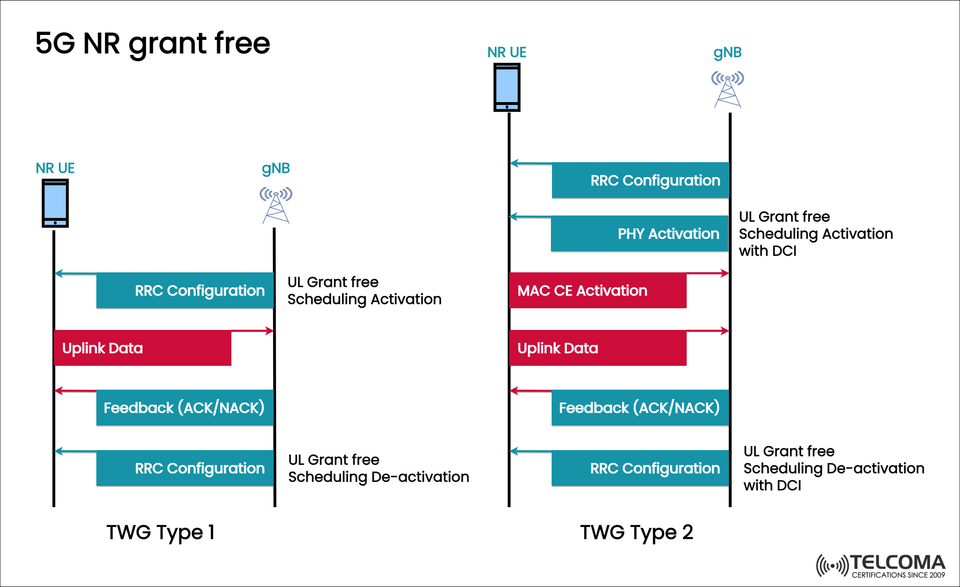
To tackle this issue, 5G NR introduces Grant-Free Uplink Transmission, allowing devices to send data without waiting for explicit scheduling grants from the network. The diagram from Telcoma shows the signaling flow for Type 1 and Type 2 Grant-Free transmissions, illustrating how these approaches enhance 5G uplink communication.
What Is 5G NR Grant-Free Transmission?
Definition
Grant-Free (GF) uplink transmission in 5G NR enables a UE to send data without waiting for dynamic scheduling grants from the gNB.
Objective
The primary goals of Grant-Free transmission include:
Lowering uplink latency
Boosting reliability for time-sensitive applications
Improving efficiency for devices that send small, frequent data packets
Where It’s Used
Grant-Free transmission is mainly used in:
URLLC (Ultra-Reliable Low-Latency Communication) — like industrial automation or autonomous driving.
mMTC (massive Machine-Type Communication) — such as IoT sensors and smart meters.
By cutting out the need for scheduling requests and grants, Grant-Free uplink significantly reduces end-to-end transmission time, paving the way for real-time responsiveness.
Grant-Based vs. Grant-Free Uplink: Main Differences
Parameter Grant-Based UL Grant-Free UL Scheduling Needs gNB grant before transmission Pre-configured or semi-static scheduling Latency Higher due to request-grant delay Very low (no grant exchange)Complexity More signaling overhead Simplified signaling Reliability Moderate High (thanks to repetition and redundancy)Typical Use Case eMBB (enhanced broadband)URLLC and mMTC
Grant-Free uplink minimizes signaling, allowing devices to transmit data instantly whenever needed.
Types of 5G NR Grant-Free Transmission
As shown in the image, 5G NR defines two main types of grant-free transmission mechanisms:
🟦 Type 1 Grant-Free Transmission (Configured Grant – CG Type 1)
In Type 1, the UE is set up via RRC (Radio Resource Control) signaling to transmit uplink data on predetermined resources without further activation signaling.
How Type 1 Works (According to the Diagram)
RRC Configuration: The gNB configures the UE with UL Grant-Free Scheduling Activation parameters, detailing the resources, time-frequency allocations, and periodicity for uplink transmissions.
Uplink Data Transmission: The UE directly sends uplink data using the preset resources — no dynamic scheduling or DCI (Downlink Control Information) is required.
Feedback (ACK/NACK): The gNB provides feedback on the received data (Acknowledgment or Negative Acknowledgment).
Deactivation: This configuration can be turned off later through another RRC message from the gNB.
Key Characteristics
Fully controlled via RRC signaling.
Static configuration — great for predictable and periodic traffic.
Less flexibility, but easier to implement.
Best for mMTC and regular uplink reports (like IoT sensors).
How Type 2 Works (According to the Diagram)
RRC Configuration: The UE receives a general RRC setup for grant-free operation parameters.
PHY Activation: Activation occurs at the physical layer, prepping UE resources.
MAC CE Activation: The Medium Access Control (MAC) layer uses a Control Element (CE) to signal the activation of grant-free resources.
Uplink Data Transmission: The UE sends data using either predefined or semi-dynamically activated resources.
Feedback (ACK/NACK): The gNB provides feedback for received packets.
Deactivation via DCI: The gNB uses DCI messages to dynamically deactivate or adjust grant-free configurations.
Key Characteristics
Controlled via DCI signaling, allowing for dynamic scheduling control.
More flexible than Type 1 — fits URLLC scenarios where frequent activation/deactivation is key.
Efficiently balances latency and resource use.
Scheduling Activation and Deactivation
The diagram outlines two main phases for both types:
Phase Type 1Type 2ActivationRRC Configuration → UL Grant-Free Scheduling Activation PHY & MAC CE Activation → UL Grant-Free Scheduling Activation with DCI Deactivation RRC Configuration → UL Grant-Free Scheduling Deactivation RRC or DCI-based Deactivation
These mechanisms give network control over grant-free transmissions to prevent resource collisions when multiple UEs are involved.
Benefits of Grant-Free Transmission in 5G NR
Grant-free uplink transmission comes with a bunch of performance and operational perks:
- Lower Latency
By avoiding the scheduling request and grant exchange, UEs can send data right away, achieving ultra-low transmission delays that's crucial for URLLC services.
- Better Network Efficiency
Cuts down on repetitive scheduling signaling, easing control channel congestion and enhancing overall system capacity.
- Higher Reliability
With methods like repetition transmission, grant-free uplink ensures that data reaches the gNB even in less-than-ideal channel conditions.
- Energy Efficiency
IoT and sensor devices see advantages from fewer control exchanges, saving battery and extending device life.
- Scalability
Supports massive IoT deployments, letting thousands of devices send small data packets without choking network resources.
Challenges and Considerations
Despite its upsides, grant-free transmission does bring some challenges:
Resource Collisions: Multiple UEs might send data at the same time using the same resources, leading to interference.
Limited Flexibility with Type 1: The static setup might waste resources during idle times.
HARQ Limitations: Handling retransmissions without dynamic scheduling needs smart HARQ management.
Adaptation Complexity: Type 2 gives flexibility but adds complexity to manage DCI signaling.
5G is tackling these issues with power control, collision detection, and adaptive scheduling algorithms.
Toward 6G and Future Enhancements
As 5G progresses to 5G-Advanced (Release 18+) and 6G, Grant-Free uplink will continue to develop:
AI-assisted scheduling to foresee and prevent resource collisions.
Non-Orthogonal Multiple Access (NOMA) for simultaneous UE transmissions.
Adaptive repetition control to dynamically balance reliability and efficiency.
These improvements will make uplink communications even more autonomous, resilient, and intelligent.
Wrap-Up
The 5G NR Grant-Free Uplink Transmission mechanism marks a significant breakthrough in achieving low-latency, high-reliability communications. As the Telcoma diagram shows:
Type 1 (RRC-based) provides simplicity and predictability — perfect for IoT and periodic data.
Type 2 (DCI/MAC CE-based) offers dynamic flexibility and fast adaptation — great for real-time URLLC traffic.