
Understanding 5GMM States at UE: A Complete Guide to 5G Mobility Management Transitions

Understanding the 5GMM State at UE: A Detailed Look at 5G Mobility Management
In the realm of 5G networks, managing mobility efficiently is key to keeping connections smooth and making the most of network resources. The 5G Mobility Management (5GMM) state machine outlines how a User Equipment (UE) moves through different stages during processes like registration, deregistration, and service requests.
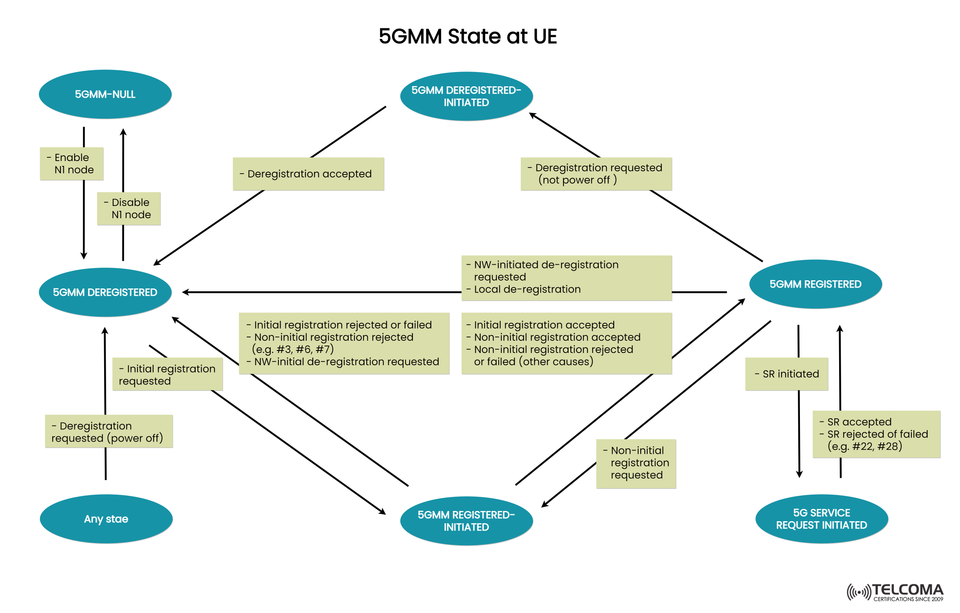
In this post, we'll take a closer look at the 5GMM state model at the UE, referring to the included flowchart to clarify each state, trigger, and transition. This is aimed at telecom experts and those who are enthusiastic about 5G.
What Is 5GMM (5G Mobility Management)?
5GMM stands for 5G Mobility Management, an essential piece of the Non-Access Stratum (NAS) protocol within the 5G Core (5GC) architecture. Its role is to oversee the registration, connection, and mobility of the UE in the network.
It functions between the UE (User Equipment) and the Access and Mobility Management Function (AMF) in the 5G Core. The key responsibilities of 5GMM include:
Handling authentication and security processes
Managing registration and deregistration
Overseeing mobility and ensuring reachability
Ensuring session continuity and managing service requests
Overview of 5GMM States at UE
The 5GMM state machine illustrates how the UE acts based on its registration and connectivity status. There are five primary states depicted in the flow diagram:
5GMM-NULL
5GMM-DEREGISTERED
5GMM-DEREGISTERED-INITIATED
5GMM-REGISTERED-INITIATED
5GMM-REGISTERED
(Sub-state) 5G Service Request Initiated
Each state marks a specific stage in the UE’s interaction with the network. Let’s delve into these states one by one.
- 5GMM-NULL State
This is the initial state for the UE before it gets the chance to connect to a 5G network. Transitions in and out of this state are governed by whether the N1 interface is enabled or disabled, linking the UE to the AMF.
Transitions:
Enable N1 node: Moves UE to 5GMM-DEREGISTERED
Disable N1 node: Returns UE to 5GMM-NULL
Basically, this is the “inactive” phase before any mobility management kicks in.
- 5GMM-DEREGISTERED State
Once the UE is enabled but hasn’t registered with a network yet, it enters the 5GMM-DEREGISTERED state. Here, the UE can conduct initial registration or deregistration processes (like when it powers off).
Key Triggers:
Initial Registration Requested: UE goes to 5GMM-REGISTERED-INITIATED.
Deregistration Requested (Power Off): UE transitions to 5GMM-NULL.
If registration gets denied, the UE remains in the deregistered state.
- 5GMM-DEREGISTERED-INITIATED State
This transitional state comes into play when the UE starts the deregistration process (not related to powering off) or when the network prompts deregistration.
Events that lead to this state:
Deregistration requested by UE (not due to power-off)
Network-initiated deregistration (like AMF release)
Transitions:
Deregistration Accepted: Moves to 5GMM-DEREGISTERED
Deregistration Requested (Not Power Off): Moves from 5GMM-REGISTERED
This state makes sure that deregistration is completed and acknowledged before going back to the deregistered state.
- 5GMM-REGISTERED-INITIATED State
This state marks the UE’s effort to register with the 5G Core Network.
Possible Triggers:
Initial registration (first-time connection)
Non-initial registration (like after a periodic update or re-registration)
Transitions:
Initial registration accepted: Moves to 5GMM-REGISTERED
Non-initial registration accepted: Moves to 5GMM-REGISTERED
Initial registration rejected or failed: Goes back to 5GMM-DEREGISTERED
Network-initiated de-registration requested: Moves to 5GMM-DEREGISTERED
This phase serves as the handshake where the UE authenticates with the AMF, implements NAS security, and gets the registration context.
- 5GMM-REGISTERED State
This is the stable, connected state when the UE is successfully registered with the 5G Core Network. Now, the UE can exchange NAS messages, submit service requests, and manage mobility.
Events within this state:
SR (Service Request) initiated: Moves to 5G Service Request Initiated
Deregistration requested: Moves to 5GMM-DEREGISTERED-INITIATED
Network-initiated deregistration: Returns to 5GMM-DEREGISTERED
The 5GMM-REGISTERED state keeps the UE’s registration valid, ensuring ongoing data sessions and signaling interactions.
- 5G Service Request Initiated
This sub-state happens when the UE sends a Service Request (SR) for resuming or establishing user-plane connectivity.
Triggers and Outcomes:
SR Accepted: UE stays in 5GMM-REGISTERED
SR Rejected or Failed: (like due to error #22 or #28) UE goes back to 5GMM-REGISTERED
This process allows UEs in idle or inactive states to reactivate their connections when there's new data activity.
Summary Table of 5GMM State Transitions
Current State | Trigger/Event | Next State
5GMM-NULL | Enable N1 node | 5GMM-DEREGISTERED
5GMM-DEREGISTERED | Initial registration requested | 5GMM-REGISTERED-INITIATED
5GMM-DEREGISTERED-INITIATED | Deregistration accepted | 5GMM-DEREGISTERED
5GMM-REGISTERED-INITIATED | Registration accepted | 5GMM-REGISTERED
5GMM-REGISTERED | Deregistration requested (not power off) | 5GMM-DEREGISTERED-INITIATED
5GMM-REGISTERED | SR initiated | 5G Service Request Initiated
Any state | Deregistration requested (power off) | 5GMM-DEREGISTERED / NULL
Key 5GMM Procedures Explained
Initial Registration
This takes place when the UE first connects to the network or powers up, involving:
Authentication and key agreement
Setting up NAS security
AMF allocation
Updating the registration area
Non-Initial Registration
This is triggered by:
Mobility events (like inter-AMF handovers)
Periodic updates for reachability
Re-attaching after temporary disconnection
Deregistration
Can happen locally (initiated by the UE) or network-initiated. Common triggers include:
Powering off the UE
Changes in subscription or policy
AMF load balancing or releasing sessions
Service Request (SR)
This lets the UE resume user-plane connectivity when in idle mode, which is crucial for quick reactivation in 5G.
Why 5GMM State Management Matters
Properly managing 5GMM states helps ensure:
Smooth user experience — no dropped calls during transitions
Reduced signaling load on the core network
Better power efficiency in UEs with smart registration cycles
Faster reconnections through efficient SR management
For telecom engineers, getting a grip on 5GMM states aids in troubleshooting issues like registration failures, signaling storms, and deregistration problems.
Conclusion
The 5GMM state model at the UE serves as the backbone for 5G NAS signaling and mobility management. Each transition — from starting registration to deregistration or service requests — is crucial for keeping UEs securely and efficiently connected to the 5G Core Network.
For telecom professionals, mastering this state machine is essential to understanding how the 5G system maintains seamless connectivity, mobility, and reliability under various network conditions.
Whether you're optimizing signaling flows, debugging NAS messages, or developing new 5G services, a solid understanding of 5GMM state transitions provides a strong technical foundation for working within modern 5G environments.