
Understanding Event A1 in 5G and LTE: Serving Becomes Better Than Threshold

Understanding Event A1: When Serving Is Better Than Threshold in 5G and LTE
In mobile communication like LTE and 5G NR, measurement reporting events are super important for keeping user equipment (UE) connected as it moves around different cells. These events are part of Radio Resource Control (RRC) procedures and help the network decide when to initiate handover, cell reselection, or link adaptation.
One such event is Event A1, which is defined as “Serving becomes better than threshold.” This means the serving cell’s signal quality has improved beyond a set threshold, indicating that the UE is in a good coverage area and doesn’t need to report on neighboring cells for now.
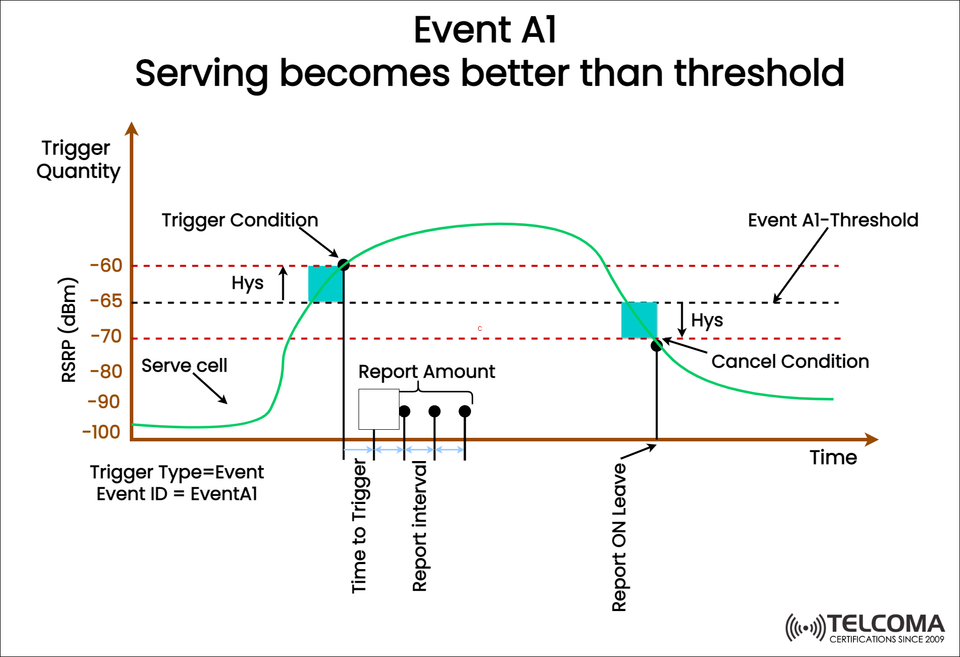
The diagram shared by Telcoma visually explains how Event A1 works, showing the trigger and cancel conditions, time-to-trigger intervals, and hysteresis values. Let's break it down step by step.
- What Is Event A1 in LTE and 5G NR?
Event A1 is a measurement event defined by 3GPP (with TS 36.331 for LTE and TS 38.331 for NR). It shows that the serving cell’s signal quality (RSRP or RSRQ) has exceeded a predefined threshold set by the network.
Technical Definition:
“Event A1 triggers when the measured value of the serving cell is better than the threshold by a specified hysteresis margin for a certain period.”
This event usually leads to the UE stopping measurement reports for neighboring cells because the serving cell already provides strong and stable connectivity.
Purpose of Event A1
Event A1 is key for improving network efficiency and cutting down unnecessary signaling. When the UE has a strong signal from its serving cell, constantly measuring neighboring cells is pointless and wastes both power and network resources.
Objectives of Event A1:
Reduce signaling overhead: No need for constant neighbor cell measurements when the signal is solid.
Enhance UE battery efficiency: The UE can save energy by pausing neighbor checks.
Maintain network stability: Avoids unnecessary handover evaluations.
Optimize mobility management: Reporting is only active when the UE’s serving cell performance changes noticeably.
In simpler terms, Event A1 tells the network that the UE is “content” in its current serving cell.
Unpacking the Event A1 Diagram
Let’s break down the diagram provided, step by step.
a. X-Axis: Time
The x-axis shows the timeline of the UE’s signal strength as it moves through the serving cell’s coverage area.
b. Y-Axis: RSRP (Reference Signal Received Power)
The y-axis represents the RSRP (in dBm), which measures the strength of the signal from the serving cell.
c. Event A1 Threshold
This horizontal line sets the configured threshold level for Event A1. When RSRP rises above this threshold (plus a slight margin called hysteresis), Event A1 is activated.
d. Hysteresis (Hys)
Hysteresis acts as a buffer zone to prevent frequent triggering and cancellation of the event due to minor fluctuations in signal strength.
Trigger Condition: RSRP ≥ (Threshold + Hysteresis)
Cancel Condition: RSRP ≤ (Threshold – Hysteresis)
This hysteresis helps ensure stability in event reporting.
e. Time to Trigger (TTT)
The Time to Trigger (TTT) parameter makes sure that the trigger condition remains for a continuous duration before Event A1 is acknowledged. This avoids false triggers from brief spikes.
f. Report Amount and Report Interval
Once the event is triggered:
Report Amount indicates how many reports the UE sends.
Report Interval specifies the timing between consecutive reports.
g. Report on Leave
If the serving cell’s RSRP falls below the cancel condition, reporting for Event A1 stops, which is referred to as Report on Leave.
Event A1 Trigger and Cancel Conditions
Trigger Condition
Event A1 is triggered when the serving cell’s RSRP or RSRQ surpasses the Event A1 threshold + hysteresis (Hys) and remains above it for at least the TTT period.
Formula:
RSRP ext{_serving} ≥ Threshold + Hys
Cancel Condition
Event A1 is canceled when the serving cell’s RSRP dips below the threshold – hysteresis, indicating a weaker signal.
Formula:
RSRP ext{_serving} ≤ Threshold – Hys
This ensures the event only activates or deactivates based on sustained and significant signal changes.
Summary of Parameters
Parameter Description Purpose Event ID Event A1Identifies the measurement event Trigger Quantity RSRP or RSRQ Measurement metric used for evaluation Threshold Configurable (e.g., -65 dBm)Defines the RSRP level for triggering Hysteresis (Hys)Typically 2–5 dB Prevents ping-pong triggering Time to Trigger (TTT)e.g., 160 ms Ensures condition persists before triggering Report Amount e. g., 4 reports Limits how many reports are sent Report Interval e.g., 120 ms Defines spacing between reports Report on Leave When signal falls below cancel condition Stops Event A1 reporting
Practical Example: Event A1 in Action
Imagine a UE moving closer to its serving gNB (or eNodeB). At first, the RSRP is -90 dBm — too weak. As it gets closer to the tower, RSRP gradually improves to -60 dBm, surpassing the Event A1 threshold of -65 dBm plus hysteresis (let’s say +2 dB = -63 dBm).
At -63 dBm: The condition meets the trigger threshold.
The network waits for the Time to Trigger duration (e.g., 160 ms) to confirm the signal improvement is stable.
Once validated, Event A1 is triggered, and the UE starts sending measurement reports at set intervals.
If the RSRP drops below -67 dBm (threshold - hysteresis), then Event A1 is canceled, and reporting ceases.
This process ensures accurate detection of genuine signal improvements while avoiding responses to fleeting fluctuations.
How Event A1 Optimizes Mobility
Event A1 plays an important role behind the scenes in mobility management. When it’s triggered, it reduces unnecessary neighbor measurements, saving both UE and network resources. When it’s canceled, it signals that neighbor monitoring should pick back up, preparing for potential handover events like Event A3 (when a neighbor becomes a better option than the serving cell).
Key Benefits:
Measurement Efficiency: Cuts down on measurement reports when serving cell quality is solid.
Battery Optimization: The UE uses less energy scanning neighboring cells.
Network Stability: Prevents bouncing between measurement reporting and idle states.
Better Resource Management: The network can focus processing resources on UEs that need more help.
Real-World Use Cases of Event A1
Indoor coverage management — eliminating unnecessary neighbor reports when the signal is strong.
Small cell environments — stabilizing connections while the UE moves through microcells.
IoT device optimization — enhancing battery life by limiting frequent measurements.
Beam stability management in 5G — ensuring reliable link maintenance.
Conclusion
Event A1 — “Serving becomes better than threshold” — plays a foundational role in LTE and 5G NR mobility management. The Telcoma diagram helps clarify the trigger and cancel conditions based on the RSRP threshold, hysteresis, and time-to-trigger parameters.
By smartly controlling when the UE starts and stops measurement reporting, Event A1:
Cuts down on signaling overhead,
Saves battery power, and
Boosts overall network efficiency.
In essence, Event A1 ensures the UE and network only communicate when genuinely necessary, striking a balance between responsiveness and stability — a crucial element for delivering seamless, high-quality 5G experiences.