
Understanding Event A2 in 5G and LTE: Serving Cell Becomes Worse Than Threshold

Understanding Event A2: When the Connection Deteriorates in LTE and 5G NR
In advanced wireless networks like LTE and 5G NR, keeping a stable connection while users are on the move is really important. The system is always checking the quality of the signal based on measurement events set by 3GPP standards (TS 36.331 for LTE and TS 38.331 for NR).
Among these is Event A2, which is key. It gets triggered when the RSRP or RSRQ of the serving cell dips below a specific threshold, indicating to the network that the connection quality is worsening. This allows for neighbor cell monitoring or preparations for a handover, ensuring smooth mobility.
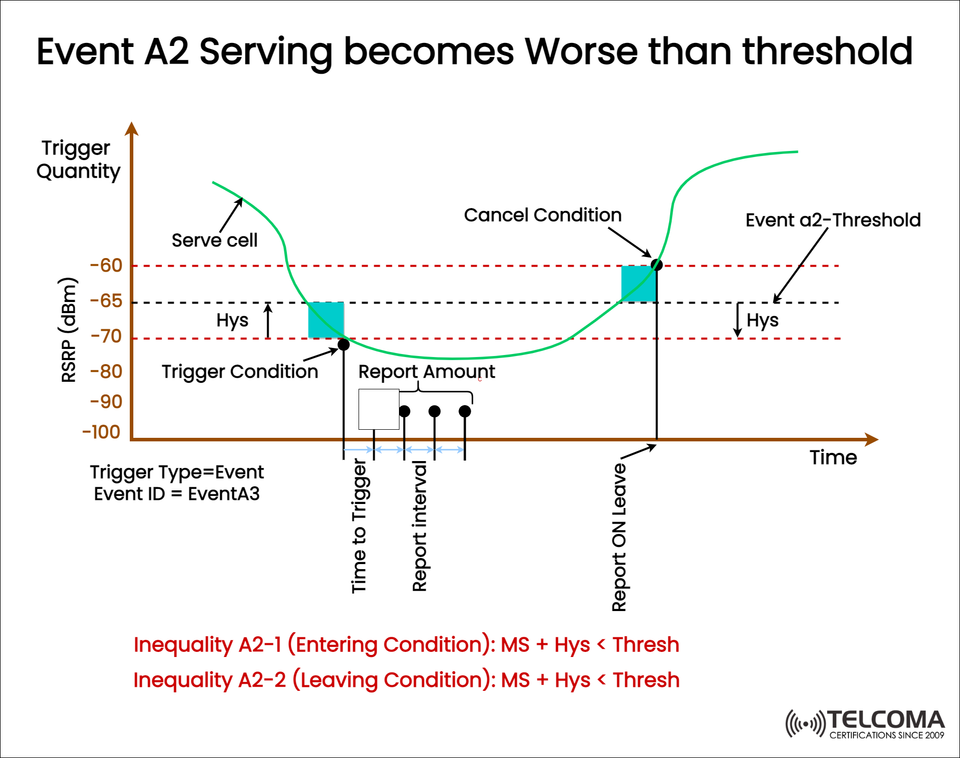
The diagram from Telcoma gives a clear visual of how Event A2 operates, illustrating everything from the trigger conditions to cancellation and reporting intervals. Let’s dive into the details.
- What Is Event A2?
Event A2 is a measurement event that happens when the serving cell's quality falls below a defined threshold.
Technical Definition:
“Event A2 is activated when the measured value of the serving cell becomes worse than the threshold by a certain margin (hysteresis) and stays in that condition for a specific time-to-trigger (TTT).”
In simpler terms, it alerts the network that the user equipment (UE) is losing signal quality, helping it get ready for possible handover decisions, resource allocation, or link recovery actions.
Understanding the Event A2 Diagram
The image shows how the serving cell's RSRP (Reference Signal Received Power) changes over time in relation to a configured threshold.
a. X-Axis: Time
The x-axis charts the passage of time as the UE’s signal moves through different coverage zones.
b. Y-Axis: RSRP (dBm)
The y-axis indicates signal strength in dBm—higher values (closer to 0) mean a stronger signal, while lower values show degradation.
c. Event A2 Threshold
The Event A2 threshold is the RSRP value that triggers the event. For instance, it could be set at -70 dBm.
d. Trigger Condition
Event A2 activates when the serving cell’s RSRP drops below the threshold minus hysteresis (Hys).
e. Cancel Condition
If the serving cell’s RSRP rises above the threshold plus hysteresis, Event A2 is canceled, indicating that conditions have improved.
f. Hysteresis (Hys)
Hysteresis provides a stability buffer to minimize frequent switching between “trigger” and “cancel” states due to minor fluctuations.
g. Time to Trigger (TTT)
This ensures that the poor condition needs to persist for a specified duration before the event is officially triggered to avoid transient false alarms.
h. Report Amount & Report Interval
When triggered, the UE sends reports to the network:
Report Amount: Total number of reports to send.
Report Interval: Time between each report.
i. Report on Leave
When conditions improve (cancel condition met), the UE sends a final “Report on Leave” indicating recovery.
Step-by-Step Operation of Event A2
Here’s a quick rundown of how the A2 process works:
Signal Starts to Drop: The UE’s serving cell signal (RSRP) slowly decreases due to movement or interference.
Crosses Threshold (Trigger Condition): When RSRP < Threshold – Hysteresis, the Trigger Condition is met.
Time to Trigger (TTT): The UE waits for the TTT duration to ensure the poor condition is stable.
Event A2 Triggered: The UE informs the network: “Serving cell signal is below threshold.”
Neighbor Measurements Begin: The network may ask the UE to start reporting neighbor cells (for example, Event A3).
Signal Recovers (Cancel Condition): When RSRP > Threshold + Hysteresis, Event A2 is canceled.
Report on Leave: The UE updates the network about the improved conditions.
Event A2 Parameters Summary Table
Parameter Description Purpose Event ID Event A2Identifies serving cell deterioration Trigger Quantity RSRP / RSRQ Measurement type for evaluation Threshold Configurable (e.g., -70 dBm)Defines trigger point Hysteresis (Hys)2–5 dB typical Prevents rapid toggling Time to Trigger (TTT)e.g., 160 ms Ensures condition persists before trigger Report Amount e.g., 4 reports Limits total reports sent Report Interval e.g., 120 ms Time between reports Cancel Condition RSRP > Threshold + Hys Stops A2 reporting Report on Leave Sent when signal recovers Ends the A2 event reporting
Practical Example of Event A2
Let's say a UE is moving away from a cell tower. Initially, the RSRP is -60 dBm (strong). As the user gets farther away:
At -68 dBm, the signal is still above the threshold.
At -72 dBm, the RSRP drops below the threshold (-70 dBm) minus hysteresis (2 dB).
After holding this for 160 ms (TTT), Event A2 is activated.
The UE reports this to the network, leading to:
Activation of neighbor cell measurements (Event A3).
Preparation for a potential handover.
Later, when the UE moves back toward the tower and the RSRP improves to -67 dBm (above threshold + Hys), Event A2 is canceled.
- Relationship Between Event A1 and Event A2
Aspect Event A1Event A2ConditionServing cell improves above threshold Serving cell worsens below threshold Purpose Stop neighbor measurements Start neighbor measurements Network Action UE stays in the current cell Prepare for handover or measuring neighbors Trigger Formula RSRP ≥ Threshold + Hys RSRP ≤ Threshold – Hys Cancel Condition RSRP ≤ Threshold – HysRSRP ≥ Threshold + Hys
Together, Event A1 and A2 create a complementary control mechanism that optimizes measurement reporting—ensuring the UE measures only when necessary.
Event A2 in 5G NR
In 5G NR, Event A2 works similarly to LTE, but it comes with added flexibility for beam-based measurements.
NR Enhancements Include:
Use of SSB RSRP, RSRQ, or SINR for triggering.
More detailed beam-level detection for events.
Support for dual connectivity (EN-DC) for coordinating LTE and NR measurements.
Integration with conditional handover and beam management strategies.
So, A2 remains a vital trigger for ensuring mobility and reliability in modern 5G setups.
Real-World Applications of Event A2
Handover readiness: UE measures neighbors when the serving signal weakens.
Cell-edge detection: Identifies when UE moves toward coverage limits.
Inter-RAT mobility: Initiates measurements for LTE-to-NR or NR-to-LTE shifts.
Beam management: In 5G, helps determine when a beam switch is necessary.
Coverage optimization: Aids operators in fine-tuning threshold settings for greater stability.
Conclusion
Event A2 – “Serving becomes worse than threshold” is crucial for maintaining high-quality mobility in LTE and 5G NR systems. As shown in the Telcoma diagram, A2 kicks in when the serving cell’s RSRP falls below a certain threshold, prompting the UE to start neighbor cell measurements or prepare for handover.
By applying parameters like hysteresis, time-to-trigger, and reporting intervals, Event A2 helps ensure stability, prevents false alarms, and boosts handover reliability.
In short, Event A2 is like the network's early warning system, letting it know when it’s time to search for a better connection—helping keep users connected as they navigate the cellular landscape.