
Event A2 in 5G and LTE: Understanding When the Serving Cell Becomes Worse Than the Threshold

Event A2 Explained: When Serving Becomes Worse Than the Threshold
In the intricate realm of wireless communication, keeping dependable connections as users move around is a constant struggle. Both LTE (Long-Term Evolution) and 5G NR (New Radio) rely heavily on effective measurement reporting systems to handle mobility and handovers smoothly.
One key measurement event is Event A2. This event kicks in when the signal strength of the serving cell dips below a configured threshold. Essentially, it alerts the network that the user's connection quality is declining, which sets off preparations for neighbor cell measurement or handover to ensure the service keeps running without interruption.
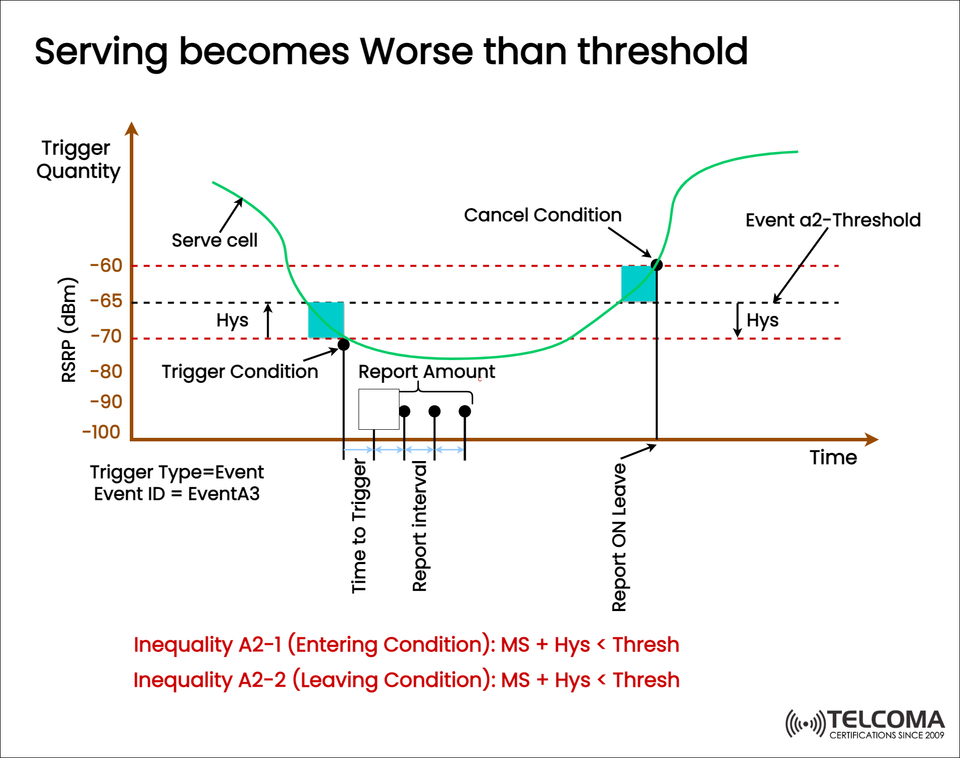
The image provided by Telcoma is really helpful in showing how Event A2 works, illustrating how it gets triggered, maintained, and canceled as signal quality changes.
Let’s break it down step by step.
What is Event A2 in LTE and 5G NR?
Event A2 is a measurement reporting condition that occurs when the quality of the serving cell falls below a set threshold.
Technical Definition (3GPP TS 36.331 / TS 38.331):
“Event A2 is triggered when the measured value of the serving cell becomes worse than the configured threshold for a specified time-to-trigger (TTT).”
This allows the gNB (in 5G) or eNode B (in LTE) to understand that a user might be entering an area with weaker coverage, prompting them to gear up for a handover or cell reselection.
Why Event A2 Matters in Network Performance
The main goal of Event A2 is to give the network a heads up when the signal quality of the serving cell drops below acceptable levels.
This alerts the network to:
Kick off neighbor cell measurements (like Event A3: when a neighbor’s signal gets better than the serving one).
Get set for a handover before the connection deteriorates any more.
Optimize performance for users who are moving quickly.
Improve user experience by preventing dropped calls or data interruptions.
In short, Event A2 acts like an early warning system, getting the network to take action before a connection fails.
Understanding the Event A2 Diagram
The Telcoma diagram clearly explains how Event A2 works.
Axes:
Y-Axis (Vertical): Shows RSRP (Reference Signal Received Power) in dBm — a measure of signal strength.
X-Axis (Horizontal): Illustrates Time — reflecting how signal quality changes as a user moves around.
Now, let’s break down the components one by one:
a. Serve Cell (Green Curve)
This line shows the signal strength (RSRP) of the serving cell over time. It fluctuates as the user moves through different environments, representing real-world signal conditions.
b. Event A2 Threshold
This is a predetermined signal strength level (for instance, -70 dBm) that determines when the event should be activated. If the serving cell’s signal drops below this level, it indicates a potential drop in coverage.
c. Hysteresis (Hys)
To avoid frequent state changes due to minor signal fluctuations, hysteresis is employed. This adds a margin around the threshold.
Trigger condition: Signal falls below Threshold - Hys
Cancel condition: Signal rises above Threshold + Hys
d. Trigger Condition
Event A2 is triggered when the serving cell’s RSRP falls below the threshold (minus hysteresis) for a specified Time to Trigger (TTT) duration.
e. Time to Trigger (TTT)
This is a configurable delay that ensures the condition is stable and not the result of temporary drops. Typical values range from 0 to 160 ms.
f. Report Amount and Interval
Once the event is triggered, the UE sends a certain number of measurement reports to the network, spaced apart by a defined report interval.
This enables the network to effectively monitor the downward trend in signal quality.
g. Cancel Condition (Report on Leave)
If the signal improves — that is, it goes above Threshold + Hys — the UE sends a final report called Report On Leave, and the event gets canceled.
Mathematical Representation of Event A2
The image shows two inequalities that outline the trigger and cancel logic:
Trigger Condition (Entering Event A2):
Ms + Hys < Threshold
When the measured signal plus hysteresis drops below the threshold, Event A2 is triggered.
Cancel Condition (Leaving Event A2):
Ms + Hys > Threshold
When the signal recovers above the threshold plus hysteresis, Event A2 is canceled.
Where:
Ms: Measured serving cell RSRP or RSRQ
Hys: Hysteresis value (dB)
Threshold: Configured event trigger value
Step-by-Step Sequence of Event A2
StepDescriptionAction1UE measures serving cell signal Continuous RSRP/RSRQ sampling2RSRP falls below (Threshold - Hys)Trigger condition met3TTT timer starts Wait for stability4Condition persists for TTT Event A2 triggered5UE sends report to gNB/eNB Network receives A2 report6Network may activate neighbor cell measurement (A3)Prepares for potential handover7RSRP rises above (Threshold + Hys)Event canceled8UE sends Report on Leave Normal operation resumes
Role of Event A2 in Mobility Management
In LTE:
Event A2 primarily serves to initiate neighbor measurements when serving cell quality declines. Networks utilize these measurements (often via Event A3) to assess the need for a handover.
In 5G NR:
Event A2 plays an even larger role:
Supports beam-based mobility, where degradation might trigger beam switching.
Aids dual connectivity (EN-DC) scenarios to manage transitions between LTE and NR.
Works alongside conditional handovers and beam failure recovery mechanisms.
Therefore, Event A2 is crucial in ensuring effective mobility management across both radio access technologies.
Comparing Event A2 and Event A1
The function of Event A2 complements that of Event A1, which identifies when the serving cell becomes better than a threshold.
Feature Event A1Event A2ConditionServing cell becomes better than threshold Serving cell becomes worse than threshold Purpose Stop measuring neighbors Start measuring neighbors Trigger Point RSRP > Threshold + Hys RSRP < Threshold - Hys Network Response Maintain current connection Prepare for handover Use Case UE returns to good coverage UE moves toward cell edge
Together, A1 and A2 ensure that measurements are taken only when necessary.
Parameter Optimization for Event A2
Network operators need to fine-tune Event A2 parameters carefully to find the right balance between handover responsiveness and stability.
Parameter Description Typical Range Threshold Defines degradation point-65 to -75 dBm Hysteresis (Hys) Prevents ping-pong triggers2–5 dB Time-to-Trigger (TTT)Stabilizes event detection0–160 ms Report Interval Time between reports120–480 ms Report Amount Number of reports sent1–8 reports
Properly tuning these parameters is key for accurate degradation detection without unnecessary signaling overhead.
Real-World Example
Imagine a UE connected to a cell with an RSRP threshold of -70 dBm and hysteresis of 2 dB:
The signal dips from -65 dBm to -73 dBm.
Since -73 dBm is less than (-70 - 2), the trigger condition is satisfied.
After 160 ms (TTT), the UE sends an Event A2 report.
The network starts monitoring neighboring cells.
If the signal later improves to above -68 dBm, Event A2 is canceled.
This cycle continues as the UE navigates through different coverage areas, allowing for dynamic mobility control.
Importance of Event A2 in 5G Mobility Scenarios
In 5G NR, Event A2 isn’t just about signal degradation; it’s a key part of beam-based and multi-layer mobility:
Beam Failure Recovery (BFR): Detects when a beam weakens.
Conditional Handover (CHO): Prepares alternative cell links before a potential failure.
Dual Connectivity (DC): Dynamically balances LTE-NR connection quality.
Inter-RAT Mobility: Manages transitions between NR, LTE, and Wi-Fi systems.
This way, Event A2 ensures a smooth experience and top-notch quality of experience (QoE), even under tough radio conditions.
Key Advantages of Event A2
Provides early warning for poor signal conditions.
Enables proactive neighbor cell monitoring.
Reduces dropped calls and throughput degradation.
Optimizes handover timing.
Ensures smooth mobility across technologies.
Conclusion
Event A2 – when serving becomes worse than the threshold – is vital for managing mobility in LTE and 5G.
As shown in the Telcoma diagram, it activates when the serving cell's RSRP or RSRQ falls below a defined threshold, prompting the UE to report this to the network. Using mechanisms like hysteresis, time-to-trigger, and reporting intervals, the network can make smart, stable, and proactive handover choices.
In short, Event A2 keeps users connected, even when the signal weakens, by guiding the network to act promptly before a connection is lost.