
Understanding Event A3: Neighbor Cell Becomes Offset Than Serving in LTE/5G Networks

Event A3 in LTE/5G: When the Neighbor Cell's Signal Gets Better than the Serving Cell
In modern cellular networks like LTE and 5G, reliable handover and mobility decisions heavily depend on event-based measurement reporting. One of the key events in this mechanism is Event A3, which flags the moment when a neighboring cell’s signal surpasses that of the serving cell by a set offset.
This process enables user equipment (UE) to shift smoothly to the strongest available cell, ensuring no call drops or dips in performance.
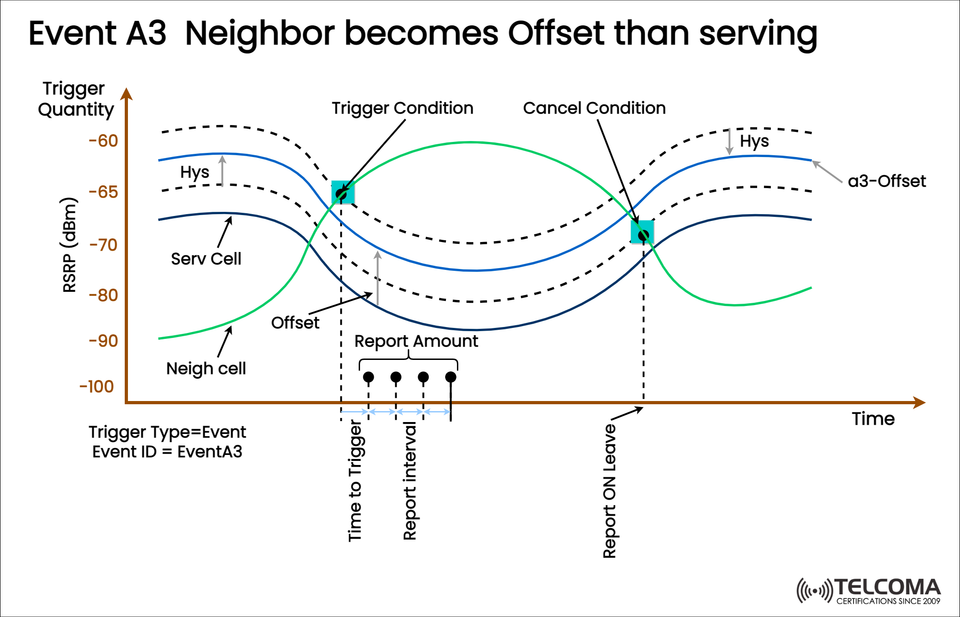
The image provided illustrates how Event A3 works—showing the conditions that trigger it, the hysteresis involved, and the circumstances under which it can be canceled, guiding the handover choices.
What Is Event A3?
Event A3 is a Radio Resource Control (RRC) measurement event utilized by LTE and 5G NR networks. Its main role is to identify when a neighbor cell is a viable option for handover.
Definition
Event A3 kicks in when:
“A neighbor cell's signal gets better than the serving cell by a specific offset.”
In simpler terms, when the Reference Signal Received Power (RSRP) or Reference Signal Received Quality (RSRQ) from the neighbor cell exceeds that of the current serving cell by a predetermined amount called the A3-offset, the UE prepares a measurement report.
Key Parameters in Event A3
Parameter | Description
RSRP / RSRQ | Reference Signal Received Power or Quality used for comparison.
A3-offset | The difference in thresholds between the serving and neighbor cells that triggers the report.
Hysteresis (Hys) | Helps avoid constant toggling of reports caused by signal changes.
Time-to-Trigger (TTT) | The length of time the condition must be true before the event is triggered.
Report Amount & Interval | Details how often and how many reports the UE sends.
Understanding the Image: Event A3 Trigger and Cancel Conditions
The image demonstrates how the signal strengths of the serving cell (represented by the blue line) and the neighbor cell (in green) fluctuate over time. Let’s break it down step by step:
- Trigger Condition
If the signal strength (RSRP/RSRQ) from the neighbor cell becomes better than that of the serving cell by more than the A3-offset, the trigger condition is met. In mathematical terms:
RSRP(Neighbor) + Hys > RSRP(Serving) + A3-offset
Once this condition is true for a minimum duration defined by the Time-to-Trigger (TTT), the UE will send an Event A3 message to the network.
- Time-to-Trigger (TTT)
The TTT acts like a buffer, helping to prevent unnecessary event triggers from transient signal quality shifts or brief fading. Only when the A3 condition holds strong beyond the TTT does the UE send a measurement report to the eNodeB (or gNodeB in 5G).
- Report Amount and Report Interval
Once the trigger condition is satisfied, the UE sends out one or more measurement reports based on specific settings:
Report Amount: How many times the UE sends the report.
Report Interval: The time gap between each consecutive report.
These parameters are crucial for ensuring that monitoring for possible handover candidates is continuous.
- Cancel Condition
The cancel condition is triggered when the signal from the serving cell strengthens again (along with hysteresis), nullifying the A3 condition. This is expressed mathematically as:
RSRP(Serving) + Hys > RSRP(Neighbor) + A3-offset
This means that once this happens, the previously triggered Event A3 is canceled, and no more reports will be sent until the trigger condition comes back into play.
Role of Hysteresis (Hys)
Hysteresis is an added dB value that helps prevent ping-pong effects, which can occur when the UE rapidly switches between cells due to minor signal variations.
Higher hysteresis: Offers more stability, resulting in fewer handovers, but may slow down reactions to changes.
Lower hysteresis: Facilitates quicker responses but increases the chance of unnecessary handovers.
In the accompanying graph, Hys appears as a vertical offset separating the trigger and cancel conditions.
Mathematical Representation of Event A3
Event A3 is governed by two primary inequalities:
Condition | Inequality | Description
Trigger Condition (Entering) | Neighbor RSRP > Serving RSRP + A3-offset + Hys | This occurs when the neighbor's signal is better by the set offset.
Cancel Condition (Leaving) | Neighbor RSRP < Serving RSRP + A3-offset - Hys | This happens when the serving cell regains the advantage.
This method guarantees stable and dependable measurement reporting, minimizing signal oscillations.
Practical Example
Let’s look at a practical scenario:
Serving Cell RSRP: –80 dBm
Neighbor Cell RSRP: –74 dBm
A3-offset: 3 dB
Hysteresis: 2 dB
Here’s how it plays out:
Trigger Condition: –74 > –80 + 3 + 2 → –74 > –75 ✅ → Event A3 triggers
Cancel Condition: –74 < –80 + 3 – 2 → –74 < –79 ❌ → Condition not canceled
Thus, the UE sends an Event A3 report indicating that the neighbor cell is now a strong contender for handover.
How Event A3 Enables Seamless Mobility
Event A3 is crucial for mobility management in LTE and 5G networks. It helps ensure:
Proactive handover decisions before the serving cell weakens too much.
Optimized user experience with steady signal quality.
Reduced call drops and better session continuity.
Efficient load balancing among neighboring cells.
Network engineers adjust A3 parameters based on several factors, including:
Network layout
Cell overlap
Speed of users (walking vs. driving)
Type of service (voice vs. data)
Differences Between Event A2 and Event A3
Parameter | Event A2 | Event A3
Definition | The serving cell gets worse than a set threshold | Neighbor cell gets better than the serving cell by an offset
Purpose | Identify poor coverage areas | Find better candidate cells for handover
Trigger Metric | Serving cell RSRP/RSRQ | Comparison between serving and neighbor cells
Typical Use | Radio link monitoring, idle to connected transitions | Active handovers during connected mode
Events A2 and A3 often complement each other:
A2 picks up when the serving cell quality dips.
A3 makes sure the UE switches to a stronger neighbor cell.
Network Optimization with Event A3
Fine-tuning the parameters for Event A3 can significantly boost network performance. Here are some optimization tips:
Adjusting A3-offset to strike a balance between early and late handovers.
Setting appropriate hysteresis to cut down on ping-pong effects.
Optimizing TTT to fit the speed of the UE (shorter for higher mobility).
Monitoring KPIs like handover success rates and dropped call counts.
Conclusion
Event A3 stands as one of the most critical measurement events in LTE and 5G, making sure user devices connect to the most reliable cell available. By detecting when a neighbor cell becomes stronger than the current serving cell by a specific offset, networks can carry out timely and effective handovers.
The concept, shown in the image, captures the balance between signal quality, hysteresis, and trigger timing, all of which are essential for stable and optimized mobility performance.
With careful tuning of A3-offset, hysteresis, and time-to-trigger, telecom engineers can enhance user experience, decrease handover failures, and uphold solid connectivity in increasingly complex mobile networks.