
Event A2 in LTE and 5G NR: Understanding When the Serving Cell Becomes Worse Than the Threshold
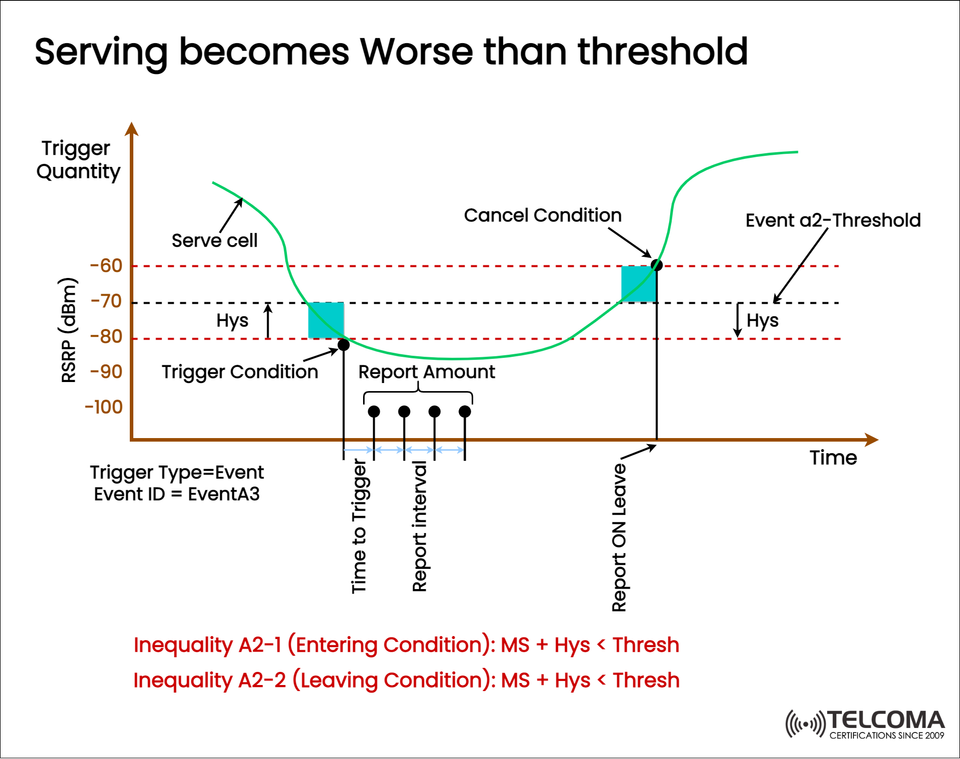

Event A2 Explained: When the Serving Cell Signals Deteriorate Beyond the Threshold
In mobile networks like LTE (Long-Term Evolution) and 5G NR (New Radio), keeping a steady connection as users move through various coverage areas is key. Measurement events are vital for monitoring radio link quality and triggering handovers when necessary.
One of these events is Event A2. It gets triggered when the signal strength of the serving cell drops below a set threshold. This helps the network realize when a user’s connection is starting to weaken, allowing it to take action to keep the service running smoothly.
The diagram from Telcoma illustrates this idea really well. It shows how Event A2 works, starting from when the serving signal dips below the threshold to when it comes back up. Let’s take a closer look.
What is Event A2 in LTE and 5G NR?
Event A2 is described by 3GPP as a measurement reporting condition where the serving cell’s RSRP (Reference Signal Received Power) or RSRQ (Reference Signal Received Quality) goes below a certain threshold.
To put it simply:
Event A2 = The serving cell signal gets weaker than the set threshold.
This event acts as a signal for the network to tell the UE (User Equipment) to measure neighboring cells. It marks the beginning of possible handover or cell reselection processes.
Importance of Event A2 in Mobility Management
Event A2 is crucial for mobility optimization and handover preparation. Here are its main roles:
Early detection of coverage issues before service quality declines significantly.
Starting neighbor cell measurements to find better options for handover.
Preventing call drops and interruptions by enabling timely transitions.
Facilitating dual connectivity and inter-RAT mobility in 5G NR and LTE networks.
Basically, Event A2 acts like an early warning that the serving cell isn’t reliable anymore.
Understanding the Diagram: When the Signal Drops Below the Threshold
The diagram offers a step-by-step visual representation of how Event A2 is triggered and canceled. Let’s break it down.
Axes:
Y-Axis: Shows the RSRP (dBm), which reflects the strength of the serving cell signal.
X-Axis: Displays Time, illustrating how the signal strength changes as the user moves.
a. Serving Cell Curve
The green curve on the diagram shows the serving cell’s RSRP over time. It demonstrates how the signal gradually weakens (as the user moves away) before improving again (as the user moves closer).
b. Event A2 Threshold
The Event A2 Threshold is the preset RSRP level (for example, -70 dBm) that determines when the event triggers. Once the serving cell’s signal falls below this level, the conditions for Event A2 start to be checked.
c. Hysteresis (Hys)
Hysteresis adds stability to the measuring process. It helps avoid frequent triggering and canceling due to minor signal fluctuations.
Trigger condition: RSRP < (Threshold - Hys)
Cancel condition: RSRP > (Threshold + Hys)
This ensures that only meaningful signal changes lead to event reports.
d. Trigger Condition
When the serving cell’s signal strength drops below the threshold (minus hysteresis) and stays there for a configured Time-to-Trigger (TTT) period, the UE triggers Event A2 and sends a measurement report to the network.
e. Time to Trigger (TTT)
The Time to Trigger parameter specifies how long the trigger condition must persist before the event is reported. This helps filter out short-term drops caused by fading or interference. Typical values range from 0 ms to 160 ms.
f. Report Amount and Report Interval
After Event A2 is triggered, the UE sends several reports to the network:
Report Amount: Number of measurement reports sent.
Report Interval: Time gap between consecutive reports.
These help the network monitor how quickly the signal is degrading and make informed decisions accordingly.
g. Cancel Condition (Report on Leave)
When the serving cell’s RSRP improves and goes above (Threshold + Hys), the cancel condition is satisfied. The UE then sends a final “Report on Leave” message to the network, indicating that Event A2 has ended.
- Event A2 Conditions: Mathematical Formulation
The image shows the mathematical conditions for entering and leaving Event A2:
Entering Condition (A2-1):
Ms + Hys < Threshold
Leaving Condition (A2-2):
Ms + Hys > Threshold
Where:
Ms = Measured signal from the serving cell (RSRP or RSRQ)
Hys = Hysteresis value (in dB)
Threshold = Configured RSRP threshold
These inequalities ensure that Event A2 only triggers when the signal drop is significant and persistent.
- Step-by-Step Sequence of Event A2 Operation
Step Event Stage Description
1 Measurement UE continuously checks the serving cell signal strength.
2 Trigger Detection RSRP falls below (Threshold - Hys).
3 Time to Trigger Timer starts; checks if the condition continues.
4 Event Trigger UE sends Event A2 report after TTT period.
5 Measurement Reporting Network may start measuring neighboring cells (e.g., Event A3).
6 Cancel Condition RSRP climbs above (Threshold + Hys).
7 Report on Leave UE sends a final report; event is canceled.
Event A2 and Neighbor Measurement
Once Event A2 gets triggered, the network can ask the UE to measure neighboring cells. This usually leads to Event A3, which indicates when a neighboring cell is performing better than the serving cell.
Together, A2 + A3 form a strong method for:
Identifying poor coverage (A2).
Finding better options (A3).
Carrying out handovers effectively.
Key Parameters Affecting Event A2 Behavior
Parameter Purpose Typical Range
Threshold (dBm) Defines when signal drops below acceptable level -65 to -80 dBm
Hysteresis (Hys) Prevents ping-pong effects 1–5 dB
Time to Trigger (TTT) Filters out transient fluctuations 0–160 ms
Report Amount Specifies number of reports sent 1–8
Report Interval Sets the frequency of reports 120–480 ms
Fine-tuning these parameters is essential for balancing responsiveness and stability in managing mobility.
Event A2 in LTE vs 5G NR
Aspect LTE (4G) 5G NR
Trigger Type Based on RSRP/RSRQ Based on RSRP, RSRQ, or SINR
Purpose Prepare for handover Manage multi-beam & dual connectivity
Use Case Cell-level mobility Beam-level mobility, BFR, CHO
Typical Follow-up Event A3 (Neighbor better than serving) A3, A5, or beam failure recovery
In 5G, Event A2 is especially critical for beam-based mobility — ensuring the UE can switch to a better beam or cell before the quality drops too low.
- Example Scenario
Let’s say a UE is connected to a serving cell with:
Threshold = -70 dBm
Hysteresis = 2 dB
TTT = 100 ms
As the UE moves away:
The serving RSRP drops to -73 dBm.
Condition Ms + Hys < Threshold → (-73 + 2 < -70) is satisfied.
The TTT timer starts ticking.
After 100 ms, if the RSRP is still below the threshold, the UE sends an Event A2 report.
The network begins measuring neighboring cells.
When the RSRP improves above -68 dBm, the event cancels, and a Report on Leave is sent.
This sequence helps ensure accurate detection and timely network response without unnecessary signaling.
Practical Uses of Event A2
Event A2 is widely applied in different scenarios across LTE and 5G networks:
Handover Preparation: Identifies when the current connection is starting to weaken.
Beam Failure Recovery (BFR): Helps spot degraded beams in 5G.
Dual Connectivity Management: Triggers activation or deactivation of secondary cells.
Coverage Optimization: Helps the network tune itself by pinpointing weak coverage areas.
Mobility KPIs Improvement: Reduces dropped calls and ensures stable throughput.
Advantages of Event A2
Early identification of poor coverage.
Prevents service degradation and dropped calls.
Supports effective handovers and beam management.
Cuts down on unnecessary measurements and signaling overhead.
Improves user experience and connection reliability.
Conclusion
Event A2 — Serving Signal Deteriorates Beyond the Threshold — is a cornerstone of LTE and 5G mobility management. It helps networks detect when the quality of the serving cell declines and prompts proactive measures like measuring neighboring cells or preparing for handovers.
As illustrated by the Telcoma diagram, Event A2 operates based on thresholds, hysteresis, and timing controls, making sure that network responses are both precise and stable.
In the advancing landscape of 5G, Event A2 remains essential — not only for cell-level mobility but also for beam-based mobility and dual connectivity, making it crucial for ensuring uninterrupted and high-quality wireless connectivity.