
Understanding Generic AI Native Architecture: The Foundation of Intelligent Telecom Networks
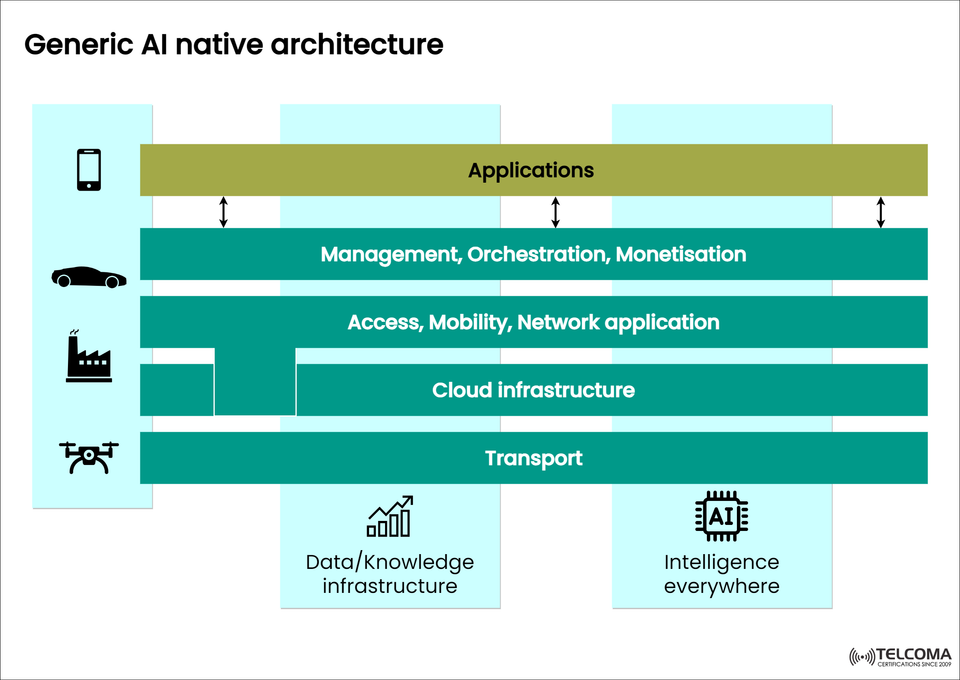

Generic AI Native Architecture: Crafting Smart, Self-Sufficient Telecom Networks
The telecom sector is rapidly moving towards 5G, 6G, and cloud-native evolution, and Artificial Intelligence (AI) has become crucial for boosting efficiency, automation, and smarter operations. To really harness the power of AI, companies need to adopt an AI native architecture — a multi-layered approach where AI isn’t just an extra feature, but an essential part of the network from the ground up.
The Generic AI Native Architecture, displayed in the image above, lays out a clear framework to understand how intelligence touches every part of a telecom ecosystem — be it transport, cloud, management, or applications. This architecture enables complete automation, dynamic orchestration, and data-led decision-making, all of which are key for next-gen telecom operations.
What Is AI Native Architecture?
An AI native architecture is designed so that AI is woven directly into every layer of the network and operations, allowing for ongoing learning, adjusting, and optimizing.
Unlike older systems that see AI as a separate component, AI native setups embed intelligence directly into the infrastructure. This means networks and apps can manage themselves, optimize on the fly, and fix problems without needing human input.
Key Goals of AI Native Architecture:
Self-directed decision-making thanks to built-in intelligence
Scalable and distributed AI throughout all areas
Instant orchestration for cloud and edge setups
Streamlined monetization and innovation in services
In the telecom world, this kind of design makes sure that networks, platforms, and services adapt fluidly to user demand, varying traffic conditions, and operational targets.
- The Layered View of Generic AI Native Architecture
The Generic AI Native Architecture is broken down into six connected layers, each with its own role. Together, they create a fully intelligent, data-driven network environment.
Let’s take a closer look at each layer.
a) Applications Layer
At the top is the Applications Layer, home to end-user and enterprise applications. This includes:
Telecom management portals
Customer-facing applications
IoT apps (like connected cars, smart factories, drones)
AI analytics and visualization tools
This layer collaborates with the management and orchestration systems to provide:
Service assurance
Network analytics
Tailored user experiences
AI plays a key role here, making sure these applications are aware of context, adjusting dynamically based on data insights, user behavior, and performance indicators.
b) Management, Orchestration, and Monetization Layer
This acts as the control layer for automating networks and managing businesses.
Key Functions:
AI-backed orchestration: Automates service delivery, scaling, and resource management.
Closed-loop management: Identifies issues and corrects them in real-time.
Monetization strategies: Uses AI-driven insights to refine pricing, service models, and SLA adherence.
In telecom networks, this layer works alongside Service Orchestrators (SO), Network Function Managers (NFM), and AI Operations (AIOps) tools to achieve zero-touch automation.
With AI integrated here, the system can manage network health while dynamically optimizing costs and revenue.
c) Access, Mobility, and Network Applications Layer
This layer is all about the heart of telecom operations — managing connectivity, mobility, and user access across varied networks.
Key Capabilities:
Dynamic radio access management (RAN and O-RAN integration)
Mobility oversight across edge and core networks
Quality of Service (QoS) enforcement using AI predictions
Instant analytics for controlling congestion and reducing latency
AI here gives networks contextual awareness, allowing them to adjust things like transmission power, routing, and handovers on the fly, based on traffic and user mobility.
This adaptability is especially important for 5G and beyond, where vast numbers of devices – like IoT gadgets, self-driving cars, and smart city infrastructure – need reliable, low-latency connections.
d) Cloud Infrastructure Layer
The cloud infrastructure serves as the computational backbone for AI native systems.
Core Functions:
Virtualized computing, storage, and network resources
AI model hosting and training setups
Edge cloud deployment for ultra-quick AI processing
AI at this level allows for predictive resource scaling, failure detection, and automated workload shifts. For telecom operators, cloud-native AI means:
Smooth network slicing
Scalable 5G operations
Efficient energy use
This layer is where AI workloads execute, running inference engines and handling data across edge, core, and multi-cloud settings.
e) Transport Layer
The Transport Layer makes sure data moves efficiently across different network domains — from users and devices to cloud and edge resources.
AI Integration:
Traffic management: AI algorithms dynamically adjust data routes based on network conditions.
Self-healing networks: Automatically detect and work around failures.
Energy-saving routing: Optimizes network use to cut down energy consumption.
In telecom, AI in the transport layer guarantees high availability, low latency, and cost-efficient connectivity, all critical for real-time services, like remote surgeries or autonomous driving.
f) Data/Knowledge Infrastructure and Intelligence Everywhere
At the base of this architecture are two vital pillars:
- Data/Knowledge Infrastructure
This is the nervous system of AI native design — allowing for data collection, storage, processing, and sharing.
Key elements include:
Unified data lakes and knowledge graphs
Metadata management and ontology-based models
Data pipelines for both training and inference
Federated learning frameworks for distributed AI
This layer ensures no data silos exist, letting insights flow freely between different network domains.
- Intelligence Everywhere
This notion means embedding AI-driven intelligence throughout every layer — from devices all the way to the cloud.
It encompasses:
AI at the edge for quick inference
AI in the core for large-scale analysis
AI in management systems for orchestration
AI in applications for tailored user experiences
In essence, “Intelligence Everywhere” means every piece can sense, decide, and act on its own, creating a cohesive, self-evolving system.
- End-to-End AI Integration: How the Layers Connect
Each layer of the AI native architecture communicates back and forth with the others. For example:
Applications provide performance feedback to the management layer, which helps with AI-based optimization.
The cloud layer offers computational power for training AI models used in orchestration and access layers.
Data infrastructure supports all layers, ensuring ongoing learning through shared insights.
This end-to-end AI integration forms a closed feedback loop, allowing the entire system to continuously learn, adapt, and optimize.
- Benefits of the AI Native Architecture
Embracing a Generic AI Native Architecture brings several clear advantages for both telecom and business settings:
Operational Benefits
Zero-touch automation with self-optimizing networks
Real-time orchestration and service assurance
Predictive maintenance and proactive issue management
Business Benefits
Faster service monetization using AI insights
Enhanced customer experiences through contextual analysis
Cost efficiency from automated resource management
Technical Benefits
Scalable and modular designs for cloud-native setups
AI integrated at every level for adaptable intelligence
Data-informed decisions across dispersed domains
- Example: AI Native Architecture in Telecom Use Case
Imagine a 5G-powered smart city network:
Transport layer: AI dynamically directs data traffic from IoT sensors.
Cloud infrastructure: Edge AI quickly processes video feeds for minimal delay.
Access and mobility: AI ensures smooth transitions between cells for autonomous vehicles.
Management layer: AI orchestrates network segments for public safety and traffic management.
Applications layer: City dashboards display real-time insights.
This interconnected system runs on its own, constantly learning and optimizing — a true demonstration of AI native design.
- Future Outlook: Towards AI-Empowered 6G Networks
As we head toward 6G, AI is set to evolve from just an optimization tool to becoming the core operations fabric of telecom systems. Future architectures will feature:
Shared AI across multiple operators
Self-evolving AI models that adjust based on real-world feedback
Complete automation from edge devices to cloud management
The Generic AI Native Architecture thus serves as the blueprint for future intelligent, autonomous networks.
Conclusion: The Foundation for Autonomous Intelligence
The Generic AI Native Architecture lays out a solid vision for embedding AI at every level of telecom — creating networks that are adaptive, intelligent, and self-sustaining.
By putting intelligence everywhere — from data infrastructure to applications — businesses can tap into unmatched agility, resilience, and innovation.
For telecom operators, adopting this architecture is more than just a tech upgrade; it’s a step towards becoming truly AI-native enterprises that can support the smart, connected world of the future.