
Understanding MEC Application, Interaction, and Service Exposure in 5G Networks

MEC Application, Interaction, and Service Exposure: Powering the Edge of 5G
As we head into a world of ultra-connected, low-latency 5G networks, traditional cloud setups are finding it tough to keep up with the demanding performance needs of real-time applications. That’s where Multi-access Edge Computing (MEC) comes in — it’s a game-changing framework that moves computing and storage closer to users, right at the edge of the network.
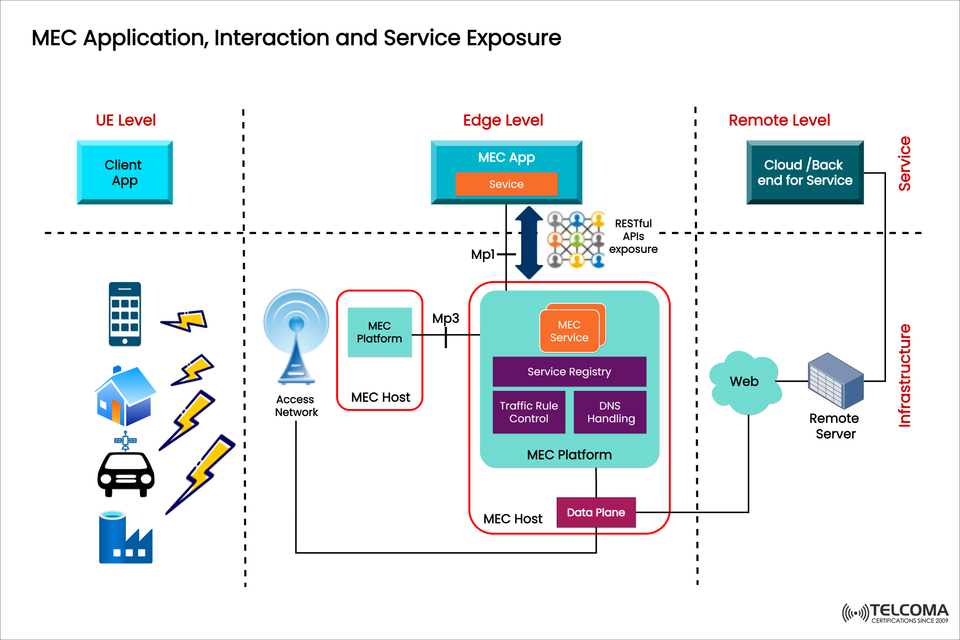
The image shows how MEC applications interact and provide services across various layers, from user equipment (UE) to edge hosts and remote clouds. This setup allows for smooth service delivery, cuts down on latency, and optimizes traffic management for next-gen applications like autonomous driving, smart factories, and IoT.
What Is MEC and Why Does It Matter?
Multi-access Edge Computing (MEC), as defined by the European Telecommunications Standards Institute (ETSI), is an architectural concept that brings cloud-computing capabilities to the network edge.
In traditional cloud models, data is sent to far-off data centers for processing. MEC changes that by shifting some of this workload closer to the end-users — within or near the radio access network (RAN) — which helps in minimizing round-trip latency and easing backhaul congestion.
Key Objectives of MEC:
Reduce latency: Getting apps closer to users.
Enhance user experience: Delivering real-time responses and high throughput.
Optimize bandwidth usage: Cut down on unnecessary traffic going to the cloud.
Enable localized services: Supporting edge-specific applications for industries, IoT, or enterprise needs.
Understanding the MEC Architecture Layers
The image breaks down the MEC ecosystem into three main levels:
UE Level (User Equipment)
Edge Level (MEC Host and Platform)
Remote Level (Cloud or Backend Service)
Each layer has its own role in managing service delivery, data flow, and application exposure.
- UE Level: The Client Application Layer
At the UE level, devices like smartphones, IoT sensors, connected vehicles, or smart home gateways run the Client App.
These applications make requests or use services from the MEC environment. For instance:
A connected car might ask for real-time traffic updates.
A smart factory sensor could send machine data for local analysis.
A gaming app might rely on edge-based rendering to minimize lag.
This client app connects with the MEC App at the edge through specific interfaces and APIs.
- Edge Level: The Core of MEC Operations
The Edge Level is where the real action happens in MEC — this is where computing, storage, and networking intelligence come together.
Key components in this layer include:
MEC Host
MEC Platform
MEC Application (MEC App)
MEC Host
The MEC Host offers the virtualized infrastructure that supports both the MEC Platform and applications. It manages compute, storage, and connectivity within the edge environment.
MEC Platform
This is the software layer that coordinates MEC services, APIs, and communication between applications and the network. According to the image, the MEC platform features:
Service Registry: Tracks available services and their APIs.
Traffic Rule Control: Optimizes the routing of user data to the right MEC app.
DNS Handling: Provides local domain resolution to cut down on lookup times.
MEC Services: Essential services that assist with application deployment and lifecycle management.
MEC Application (MEC App)
This part is where edge-optimized applications are hosted, such as:
Local content caching
Video analytics
Augmented reality processing
IoT gateway functions
The MEC App communicates with the MEC Platform via a standardized reference interface called Mp1.
Mp1 Interface: RESTful APIs for Service Exposure
The Mp1 interface, shown in the image, is a standardized link that enables communication between MEC applications and the MEC platform. It supports RESTful APIs, allowing developers to easily expose, discover, and consume services throughout the edge network.
For example, an app can:
Request details about local resources.
Subscribe to service updates.
Dynamically discover nearby MEC services.
This open API approach is what makes MEC an ecosystem-friendly and accessible platform for developers, not just a network feature.
- Remote Level: Cloud and Backend Integration
While MEC focuses on local processing, not everything can reside at the edge. Some tasks require remote cloud coordination or backend data storage.
At the Remote Level, the Cloud/Backend for Service links to the Edge Level through web or private interfaces.
This arrangement ensures:
Centralized control and analytics for global applications.
Data synchronization between edge and cloud.
Backup and scaling support when edge resources are maxed out.
For instance, in a connected vehicle system:
The MEC App manages real-time hazard detection locally.
The remote cloud collects historical driving data for AI training.
How MEC Enables Service Exposure
Service exposure in MEC refers to how its functionalities are made available to external systems and developers through standardized APIs.
Through RESTful APIs, MEC reveals:
Platform services: Like location info, bandwidth status, and device context.
Application services: Such as video optimization, caching, or analytics.
Benefits of MEC Service Exposure:
Interoperability: Any third-party app can communicate using standard APIs.
Flexibility: Services can be mixed or orchestrated dynamically.
Innovation: Developers can quickly build localized or latency-sensitive services.
MEC Application and Network Interaction
The interaction between the MEC Platform and the Access Network (RAN) is depicted via the Mp3 interface in the diagram.
This interface ensures:
Data packets are routed efficiently between the RAN and the correct MEC application.
Network functions, such as DNS and traffic control, can adjust dynamically to user needs.
Real-time services like AR/VR experience minimal delays.
This integrated setup allows telecom operators to deliver latency under 10 ms, making it feasible for critical applications like:
Autonomous vehicles
Smart grid management
Remote surgeries
Industrial automation
Key Advantages of MEC Integration
Advantage Description Ultra-low latency Processes data locally at the edge instead of sending it to distant data centers. Optimized bandwidth usage Cuts down backhaul traffic by processing at the edge. Enhanced security Localized data processing limits exposure to outside networks. Service localization Supports region-specific services, like local caching or content filtering. Improved QoE (Quality of Experience)Ensures consistent user experience even in high-demand situations.
Use Cases Empowered by MEC
Smart Cities: Managing real-time traffic and surveillance analytics.
Autonomous Vehicles: Local decision-making for avoiding collisions.
Industry 4.0: Edge-based machine control and preventive maintenance.
Healthcare: Low-latency remote diagnostics and AR-assisted surgeries.
Gaming and AR/VR: Edge rendering for seamless experiences.
Challenges in MEC Deployment
While MEC presents many advantages, it also has its share of challenges:
Standardization and interoperability with different vendors.
Security and privacy concerns at distributed nodes.
Complexity in integrating with existing telecom infrastructure.
Handling the operational management of numerous edge nodes.
Current standardization efforts by ETSI ISG MEC and 3GPP are working to tackle these issues, aiming for a unified, secure, and scalable MEC ecosystem.
Conclusion
The image clearly demonstrates how MEC applications, interactions, and service exposure are essential to today's 5G architecture.
By shifting computing power from centralized clouds to localized edge platforms, MEC offers real-time performance, efficient bandwidth usage, and improved user experiences across various sectors — from connected vehicles to smart factories.
With open APIs and multi-layer integration, MEC is turning the network edge into a dynamic, service-rich environment, bridging the gap between cloud intelligence and real-world applications.
In the era of 5G and beyond, MEC isn’t just an upgrade — it’s the backbone of next-gen connectivity.