
Understanding MIB and SIBs in 5G NR: How the UE and gNB Exchange System Information
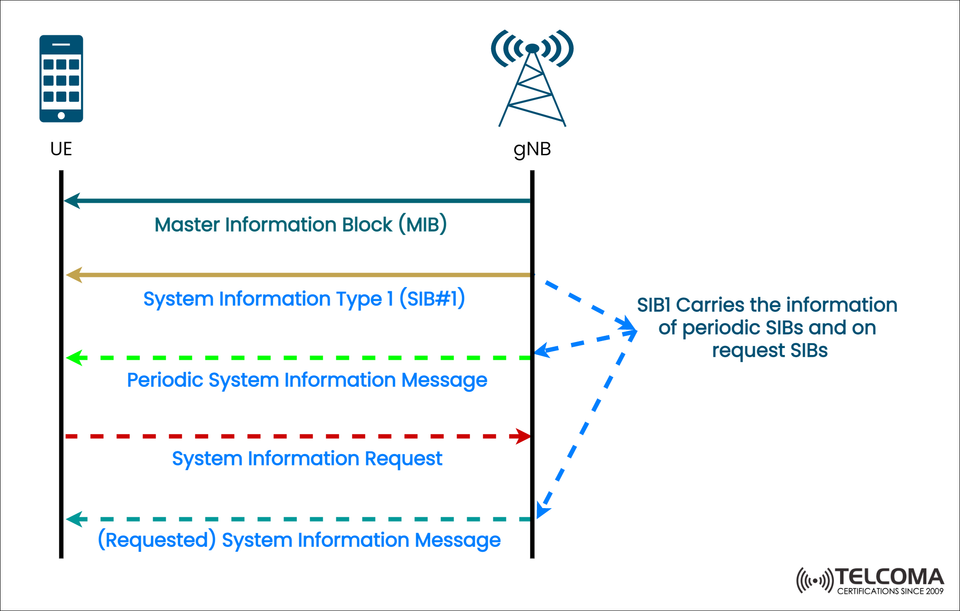

Understanding MIB and SIBs in 5G NR: UE and gNB System Information Exchange
When a device (UE) wants to connect to a cellular network, the first thing it needs to do is get a sense of its surroundings. In 5G New Radio (NR), this is done through the System Information (SI) sent out by the gNB (Next Generation NodeB).
The image provided shows how the system information exchange works between the UE and gNB. It highlights the roles of the Master Information Block (MIB), System Information Block Type 1 (SIB1), and other SIB messages that can be both periodic and requested on demand.
Let’s explore how this process operates, why it matters, and how it enables smooth communication and connectivity in 5G NR.
Overview: System Information in 5G NR
System Information (SI) gives the UE important parameters to access the 5G network, camp on a cell, and maintain communication. These parameters dictate how the UE should interact with the cell, conduct random access, and keep track of mobility.
5G NR system information falls into two main categories:
Master Information Block (MIB)
System Information Blocks (SIBs)
These messages are sent out by the gNB and decoded by the UE at various stages during the connection process.
- Master Information Block (MIB): The First Step
The MIB is the first piece of information the UE decodes upon spotting a 5G cell.
In the image, the MIB message is shown as the top arrow going from gNB to UE — it’s broadcast on the Broadcast Channel (BCH) using the Physical Broadcast Channel (PBCH).
MIB Characteristics:
Broadcast periodically over the PBCH.
Contains essential system-level parameters needed for initial syncing.
Assists the UE in decoding SIB1.
Key Information in MIB:
Parameter Description Subcarrier spacing for SIB1Tells the numerology for control channels. System frame number (SFN)Gives the frame timing for synchronization. PDCCH configuration Helps the UE locate control channels. Cell Barred information Indicates if the cell is available for camping. PLMN broadcast indication Shows if multiple networks are available in the cell.
Once the UE decodes the MIB, it can move on to retrieve the System Information Block Type 1 (SIB1).
- System Information Block Type 1 (SIB1)
After obtaining the MIB, the UE seeks out SIB1, which contains more detailed configuration info about the cell.
In the image, SIB1 is the second message sent from gNB to UE after the MIB.
SIB1 essentially serves as a directory, informing the UE:
Which SIBs are broadcast periodically, and
Which SIBs can be requested on demand.
That’s why the image notes:
“SIB1 carries details about periodic SIBs and those that can be requested.”
SIB1 Transmission Details:
Delivered through the DL-SCH (Downlink Shared Channel) using RRC (Radio Resource Control) messages.
Broadcast periodically at set intervals (usually every 160 ms or 320 ms).
The UE can decode it after successfully syncing using MIB parameters.
- Periodic System Information Blocks
Once the UE gets SIB1, it learns about additional periodic SIBs — these are system information messages sent out at regular intervals.
This step is illustrated in the image by the green dashed arrow labeled Periodic System Information Message.
Examples of Periodic SIBs:
SIB TypePurposeSIB2Radio resource settings for RACH (Random Access).SIB3Parameters for cell re-selection during intra-frequency mobility.SIB4–SIB8Information about neighboring cells for inter-frequency and inter-RAT mobility.SIB9GPS time info for synchronization.
Purpose of Periodic SIBs:
Provide consistent data needed by all UEs.
Cut down on signaling load by broadcasting frequently needed info.
Key Benefits:
Efficiency: Reduces the need for on-demand requests.
Coverage: Makes sure all UEs get crucial info, whether they're idle or connected.
- On-Request System Information
In 5G NR, not every SIB is sent out periodically. Some are transmitted only when the UE requests them, helping to enhance air-interface efficiency.
This concept is illustrated in the image with the red and blue dashed arrows:
System Information Request (UE → gNB)
(Requested) System Information Message (gNB → UE)
Procedure:
UE identifies the info it’s missing or needs (via the SIB1 index list).
The UE sends a System Information Request message to the gNB.
The gNB replies with the Requested System Information Message, which contains the specific SIB(s).
Examples of On-Request SIBs:
SIB TypePurposeSIB10Earthquake and Tsunami Warning System (ETWS).SIB12Commercial Mobile Alert System (CMAS).SIB14–SIB19Various operator-specific or regional services.
Advantages of On-Request SIBs:
Conserves bandwidth by avoiding unnecessary broadcasts.
Reduces interference, especially in crowded urban areas.
Boosts network efficiency by adapting to UE needs dynamically.
- How MIB and SIBs Work Together
Let’s sum up the flow of events using both the image and the process explanation:
MIB Broadcast: * gNB sends MIB via PBCH. * UE decodes MIB to sync and find control channel settings.
SIB1 Decoding: * UE reads SIB1 (via DL-SCH). * Learns which SIBs are periodic and which are on-demand.
Periodic SIB Reception: * UE automatically picks up periodic SIBs like SIB2, SIB3, etc.
On-Request SIB Retrieval: * If UE requires more info, it sends a System Information Request. * gNB responds with the Requested System Information Message that includes specific SIBs.
This structured approach ensures that every UE has the necessary configuration to communicate effectively while also keeping network resources in check.
- Key Differences Between MIB, SIB1, and Other SIBs
ParameterMIBSIB1Other SIBs Purpose Basic cell access and sync Index for other SIBs Detailed operational info Broadcast Method PBCHDL-SCHDL-SCH Transmission Type Always periodic Periodic Periodic or on-demand Access Dependency Decoded first Decoded after MIB Decoded after SIB1FrequencyEvery 80 ms160–320 ms Configurable
Significance of SIB Optimization in 5G
The flexible nature of system information in 5G NR (with both on-demand and periodic SIBs) provides several operational benefits:
A. Efficient Spectrum Utilization
Only crucial SIBs are transmitted periodically, reducing overhead.
B. Faster Network Access
UEs can connect to a cell quickly using just MIB and SIB1, which helps improve attach latency.
C. Reduced Power Consumption
UEs in idle or low-power modes can selectively decode only the SIBs they need.
D. Enhanced Scalability
Operators can customize SIB broadcasting based on the deployment scenario — whether it’s urban, rural, IoT, or private enterprise networks.
Conclusion
The 5G NR system information process, as illustrated in the image, showcases the seamless interaction between the UE and gNB. Starting from the MIB and moving to SIB1, followed by periodic and on-request SIBs, this organized approach guarantees:
Quick and efficient cell access,
Lower signaling load,
Optimized network performance.
By effectively managing how and when system information is shared, 5G networks achieve both efficiency and scalability, catering to a range of devices and services in the ever-evolving digital landscape.
For those in telecom, grasping the connection between MIB, SIB1, and other SIBs is crucial for designing, configuring, and fine-tuning 5G networks.