
Understanding the 5G NR Physical Resource Block (PRB): Time-Frequency Structure and Numerology

5G NR Physical Resource Block (PRB): The Foundation of Wireless Communication
In 5G New Radio (NR), making the best use of spectrum and having the flexibility to adapt are crucial for achieving high data rates, super-low latency, and massive connectivity. At the core of this setup is the Physical Resource Block (PRB), which is the basic unit used for resource allocation in the 5G time-frequency grid.
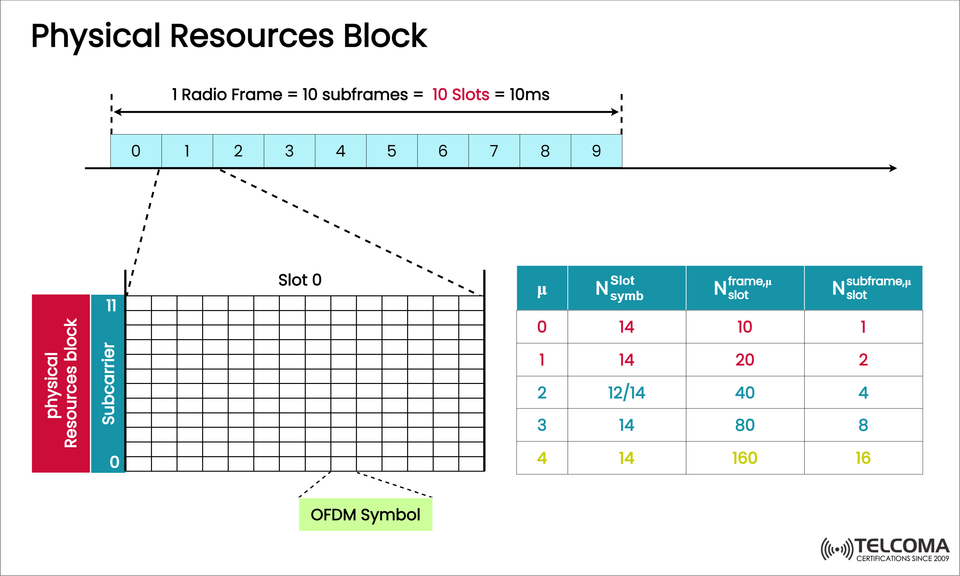
The image included gives a clear visual of the 5G NR frame structure and how a PRB is composed. It shows how subcarriers, OFDM symbols, and numerology (μ) work together to define the time-frequency allocation of resources.
This article dives deep into what a PRB is, where it fits in the 5G radio frame, and how its configuration varies with different numerologies.
What is a Physical Resource Block (PRB)?
A Physical Resource Block (PRB) is the smallest unit of frequency-time resource that can be assigned to a user in a 5G NR network.
Think of it as a two-dimensional resource element, defined by:
12 subcarriers in the frequency domain, and
One slot (14 OFDM symbols) in the time domain.
Basically, a PRB is a rectangular block in the time-frequency grid that dictates how data is sent or received over the air interface.
Overview of the 5G Frame Structure
The top section of the image illustrates the 5G NR frame structure:
1 radio frame = 10 subframes = 10 ms
Each subframe = 1 ms
The number of slots per subframe depends on the numerology (μ)
This scalable slot framework allows 5G to efficiently adapt to various frequency bands and use cases, like enhanced mobile broadband (eMBB) or ultra-reliable low-latency communication (URLLC).
The Connection Between Numerology (μ), Subcarrier Spacing, and Slots
5G NR brings in flexible numerology (μ) to support different subcarrier spacing values. The subcarrier spacing (Δf) is defined as:
Δf=15 kHz×2μ
Numerology (μ) | Subcarrier Spacing (Δf) | Typical Frequency Range
0 | 15 kHz | FR1 (Sub-6 GHz)
1 | 30 kHz | FR1 (C-band)
2 | 60 kHz | FR1/FR2
3 | 120 kHz | FR2 (mmWave)
4 | 240 kHz | FR2 (High mmWave)
Each increase in μ doubles the subcarrier spacing and reduces the symbol duration, helping 5G achieve lower latency and better bandwidth efficiency at higher frequency bands.
Frame, Subframe, and Slot Structure
According to the image:
1 radio frame = 10 subframes = 10 ms
The number of slots per frame increases with μ (numerology)
Each slot consists of OFDM symbols, which serve as the basic units of transmission time
μ | No. of OFDM Symbols per Slot (Nₛₗₒₜₛᵧₘᵦ) | Slots per Frame (N₍frame,μ₎) | Slots per Subframe (N₍subframe,μ₎)
0 | 14 | 10 | 1
1 | 14 | 20 | 2
2 | 12 | 40 | 4
3 | 14 | 80 | 8
This shows:
For μ=0 (15 kHz), there are 10 slots per frame (each slot lasts 1 ms).
For μ=3 (120 kHz), there are 80 slots per frame, meaning each slot is shorter — which is perfect for low-latency mmWave communication.
Understanding the Time-Frequency Grid
In the image, the time-frequency grid is shown as a rectangular layout:
The vertical axis shows subcarriers (frequency domain).
The horizontal axis shows OFDM symbols (time domain).
Each tiny square in the grid is a Resource Element (RE), which carries one modulation symbol (like QPSK, 16QAM, 64QAM).
A Physical Resource Block (PRB) consists of:
12 subcarriers × Nₛₗₒₜₛᵧₘᵦ OFDM symbols, where Nₛₗₒₜₛᵧₘᵦ = 14 in most cases.
Hence, a PRB generally has 12 × 14 = 168 Resource Elements (REs).
Time Domain: OFDM Symbols and Slots
An OFDM symbol is the fundamental time-domain unit for transmission, and slots are made up of multiple OFDM symbols.
Each slot typically has 14 OFDM symbols (with a normal cyclic prefix).
The slot duration varies with numerology:
Tslot=1 ms2μ
μ | Subcarrier Spacing (kHz) | Slot Duration (ms) | Slots per 10ms Frame
0 | 15 | 1 | 10
1 | 30 | 0.5 | 20
2 | 60 | 0.25 | 40
3 | 120 | 0.125 | 80
4 | 240 | 0.0625 | 160
This shows how 5G's slot structure adjusts to meet different latency and throughput needs.
Frequency Domain: Subcarriers and Resource Blocks
Each subcarrier occupies a specific frequency spacing (Δf).
A PRB comprises 12 adjacent subcarriers over one slot duration.
The total number of PRBs per carrier depends on the combined bandwidth and subcarrier spacing.
For example: With a 100 MHz carrier and 30 kHz SCS, you could fit around 273 PRBs.
This flexibility lets operators dynamically assign PRBs to users based on:
Channel conditions
Type of service (eMBB, URLLC, or mMTC)
Quality of Service (QoS) priorities
PRB Allocation and Scheduling
The 5G scheduler allocates PRBs dynamically every Transmission Time Interval (TTI) — typically one slot.
Key factors that influence PRB allocation include:
Channel quality indicators (CQI)
Modulation and coding scheme (MCS)
User priority and QoS class
Available bandwidth
Each PRB carries data (PDSCH) and control information (PDCCH), depending on the scheduling instructions.
How Numerology Affects PRB Configuration
Numerology (μ) impacts PRB structure in various ways:
Subcarrier spacing: A higher μ means a larger Δf, resulting in broader PRBs in frequency.
Slot duration: A higher μ shortens the slot, helping reduce latency.
Number of PRBs: At the same bandwidth, a higher μ results in fewer PRBs.
This adaptability allows 5G NR to:
Optimize coverage for low-band (FR1)
Maximize speed for high-band (FR2)
For example:
μ=0 → Long symbols, wide coverage (like rural areas)
μ=3 → Short symbols, high throughput (like in urban mmWave spots)
Example Calculation
Let’s look at μ = 1 (30 kHz SCS):
One PRB = 12 × 30 kHz = 360 kHz
Each slot = 14 symbols × 0.5 ms = 0.5 ms duration
For a 100 MHz channel, the number of PRBs is about 100 MHz / 0.36 MHz ≈ 277 PRBs (actually 273 as defined in 3GPP).
This layout strikes a good balance between capacity and coverage, which is why 30 kHz SCS is commonly used in mid-band 5G settings (like C-band, n78).
Benefits of 5G PRB Design
- Flexibility
Can support various numerologies for different deployment scenarios.
- Efficiency
Allows for precise spectrum resource allocation, maximizing usage.
- Scalability
Works smoothly across FR1 and FR2 bands, adapting as needed.
- Low Latency
Smaller slots with higher μ values help enable real-time applications like V2X and remote surgery.
- Improved Spectral Efficiency
OFDM-based PRBs support high-order modulation (256QAM) and MIMO transmission.
Comparing 4G LTE and 5G NR PRBs
Aspect | 4G LTE | 5G NR
Subcarrier Spacing | 15 kHz (fixed) | 15–240 kHz (scalable)
Slot Duration | 1 ms | Variable (1–0.0625 ms)
Numerology | Single | Multiple (μ = 0–4)
Flexibility | Limited | High
Frequency Range | <6 GHz | FR1 + FR2 (up to 52.6 GHz)
This table illustrates how 5G NR expands on the foundation of LTE with multi-numerology support, allowing for unprecedented adaptability.
Conclusion
The Physical Resource Block (PRB) is vital to the flexible and scalable air interface of 5G NR. It determines how the available radio spectrum is divided in both time and frequency, enabling effective scheduling and data transmission.
By combining variable subcarrier spacing, scalable slot durations, and dynamic PRB allocation, 5G can provide the agility necessary to support everything from wide-area IoT to ultra-fast mmWave broadband.
For telecom professionals, understanding the PRB structure is key to grasping how 5G adapts dynamically to network demands — ensuring optimized performance, low latency, and a top-notch user experience across all deployment scenarios.