
Understanding the Rx Reference Point in the PCC Architecture: A Complete Guide for Telecom Engineers
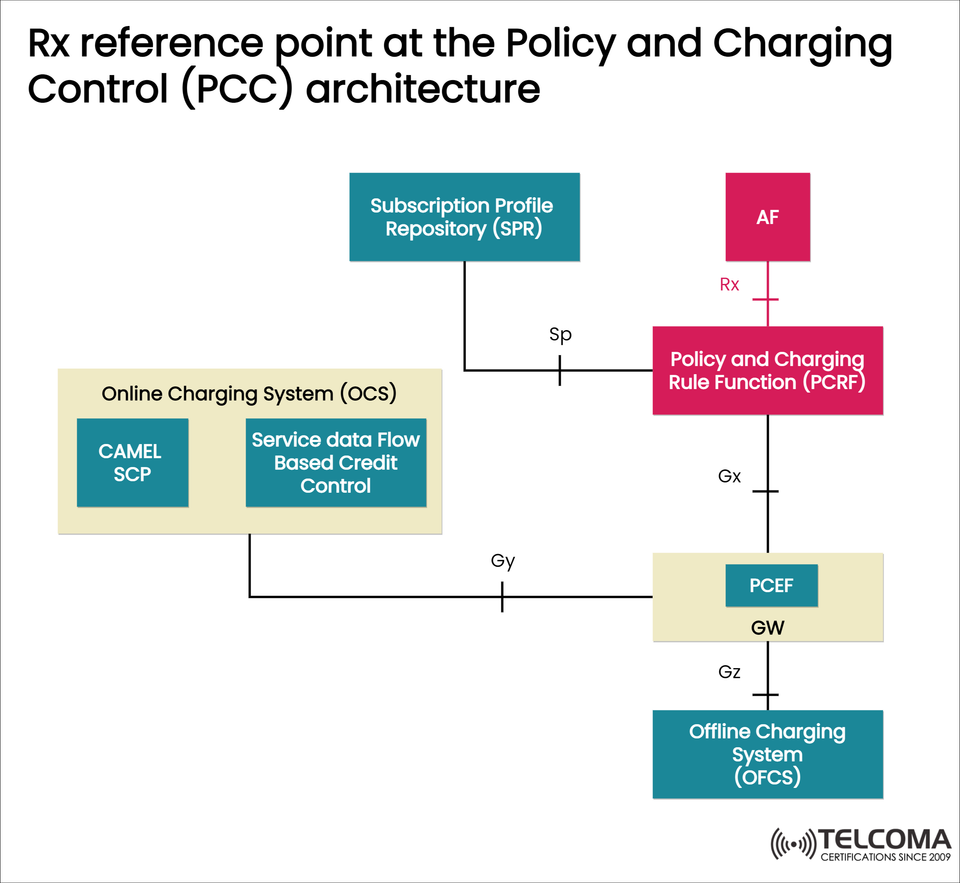

Understanding the Rx Reference Point in PCC Architecture
In mobile core networks, Policy and Charging Control (PCC) is crucial for effectively overseeing Quality of Service (QoS), user policies, and charging systems. The Rx reference point, as illustrated in the accompanying image, serves as an essential link between the Application Function (AF) and the Policy and Charging Rules Function (PCRF), facilitating smart and dynamic service delivery.
Getting a grasp on how the Rx interface fits into the larger PCC framework helps telecom professionals comprehend how operators can earn revenue from data traffic, enforce policies, and enhance user experiences.
What Is the Policy and Charging Control (PCC) Architecture?
The PCC architecture, outlined by the 3GPP (3rd Generation Partnership Project), offers a standardized system for managing policy control and charging in mobile networks, covering 3G, LTE, and 5G.
Its main goals include:
Enforcing QoS (Quality of Service) for individual users or services.
Enabling real-time decisions regarding charging and policies.
Ensuring a consistent service experience across various applications.
The PCC framework combines policy decision elements with charging controls, allowing the network to dynamically handle traffic based on user profiles, subscriptions, and current network conditions.
Core Components of PCC Architecture
The image highlights the key logical components within PCC:
Component Full Name Primary Function AF Application Function Requests policy control and QoS authorization from the PCRF. PCRF Policy and Charging Rules Function Central brain that makes real-time policy and charging decisions. PCEF Policy and Charging Enforcement Function Enforces policy rules and charging actions at the gateway. OCS Online Charging System Manages real-time credit control and prepaid charging. OFCS Offline Charging System Handles postpaid charging and billing data. SPR Subscription Profile Repository Stores user subscription data and policy-related information.
Each component connects via standardized reference points (interfaces) like Rx, Gx, Gy, Gz, and Sp to share policy, charging, and subscriber info.
Understanding the Rx Reference Point
The Rx interface is the communication link between the:
Application Function (AF)
Policy and Charging Rules Function (PCRF).
Purpose of the Rx Reference Point
This interface allows applications and services (like IMS, VoLTE, video streaming, or gaming platforms) to request network resources or QoS handling from the PCRF.
In turn, this ensures that the requirements of applications are effectively translated into suitable network policies, leading to better user experience and network efficiency.
Rx Reference Point: Functions and Responsibilities
The Rx interface serves several key functions:
Dynamic Policy Control
Applications communicate with the PCRF via AF to request specific policies, such as:
Bandwidth guarantees,
Latency targets,
Priority management for real-time services (e.g., voice or video calls).
The PCRF then turns these requests into QoS and traffic management policies.
QoS Authorization
The Rx reference facilitates application-driven enforcement of QoS. For instance:
A VoLTE session needs high reliability and low latency.
The AF (like the IMS Application Server) notifies the PCRF of this need through Rx.
The PCRF checks policies, subscription data, and network load before approving the QoS.
Charging Control
Rx enables the AF to signal to the PCRF whether a service needs online or offline charging. The PCRF then coordinates with:
OCS (Online Charging System) via Gy, or
OFCS (Offline Charging System) via Gz, to manage real-time billing or postpaid accounts respectively.
Session and Event Triggers
AF can inform the PCRF about important session lifecycle events, such as:
Starting a session,
Modifications (like QoS updates),
Ending a session.
These updates allow the PCRF to adjust network behavior when necessary.
Resource Allocation and Release
The Rx interface aids in dynamic resource management, letting the PCRF free up or reassign network resources once a service concludes, which helps in better spectrum and bandwidth management.
Rx Reference Point in PCC: Interfaces and Interactions
The image from Telcoma Global shows how Rx fits into the overall PCC ecosystem. Here’s a look at how these interfaces work together:
Reference Point Connecting Entities Functionality RxAF ↔ PCRF Manages application-level policy and QoS requests. Sp SPR ↔ PCRF Supplies subscriber policy and profile data. Gx PCRF ↔ PCEF Sends policy decisions and charging rules for enforcement. Gy PCEF ↔ OCS Supports real-time (online) charging using Diameter Credit-Control. Gz PCEF ↔ OFCS Provides usage data records for offline billing.
Example: How the Rx Interface Works in a Real Network Scenario
Let’s look at a VoLTE (Voice over LTE) call setup as an example.
Step 1: Service Request
When a user starts a VoLTE call, the IMS Application Function (AF) catches the session setup request.
Step 2: QoS and Policy Request
The AF sends an AA-Request (AAR) message to the PCRF through the Rx interface. This message contains:
Media type (voice/video),
Bandwidth needs,
Priority level,
Session identifiers.
Step 3: Policy Decision
The PCRF assesses:
User’s subscription profile (from SPR via Sp),
Network conditions,
Operator policies.
It then creates policy rules that include:
Creating a dedicated bearer,
Assigning a QoS class identifier (QCI),
Setting up charging rules.
Step 4: Policy Enforcement
These rules are sent to the PCEF through the Gx interface, which configures the gateway (GW) to enforce the QoS and charging policies.
Step 5: Charging Coordination
If the user is on a prepaid plan:
The PCEF talks to the OCS via Gy to check real-time balances. For postpaid users:
The PCEF sends charging details to OFCS via Gz for billing.
This whole process ensures that both service quality and charging are managed seamlessly through the Rx-PCC interaction model.
Advantages of the Rx Interface in PCC Architecture
The Rx reference point offers various technical and operational advantages:
Enhanced Service Quality
By aligning requests from applications with network policies, providers can guarantee consistent QoS across sessions.
Efficient Resource Utilization
Dynamic policy decisions help make sure that bandwidth and network capacity are used efficiently, reducing congestion.
Real-Time Charging Flexibility
Integration with OCS allows operators to monetize data and content services in real time, supporting prepaid and hybrid billing models.
Seamless User Experience
Subscribers can enjoy uninterrupted services with top-notch performance, no matter the session type or location.
Standardized Interoperability
Defined by 3GPP TS 29.214, the Rx interface ensures that it can work with different vendors and applications, which is critical in multi-vendor setups.
Technical Protocols Used in Rx Interface
Typically, the Rx interface uses:
Diameter Protocol for signaling, including:
AA-Request (AAR),
AA-Answer (AAA),
Session-Termination-Request (STR),
Session-Termination-Answer (STA).
These Diameter messages carry session control, authorization, and policy parameters between the AF and the PCRF.
Rx Interface in the 5G Context
In 5G Core (5GC), PCC develops into the Policy Control Function (PCF) framework. While the core idea of the Rx reference remains, it is replaced by N5/N7 interfaces:
AF ↔ PCF (N5) supersedes Rx.
SMF ↔ PCF (N7) replaces Gx.
The principle stays the same — application-driven policy control — but now utilizes service-based architecture (SBA) and HTTP/2 APIs for improved scalability and cloud-native flexibility.
Conclusion: Why Rx Reference Point Matters
The Rx reference point is the crucial connection between application services and network policy management. It empowers the PCC framework to provide real-time, user-specific QoS and charging — essential for generating revenue from data in 4G and 5G networks.
By enabling dynamic policy enforcement, flexible QoS, and real-time charging, the Rx interface ensures that both operators and users reap the benefits of optimal service quality, network efficiency, and fair billing.
As we move towards 5G-Advanced, understanding the role of the Rx reference point prepares telecom professionals to design and manage next-gen, policy-driven networks effectively.