
Understanding the Two-Tier HetNet Model in 5G: Macro Cells, Small Cells, and New Radio Access

A Comprehensive Look at the Two-Tier HetNet Model in 5G
As 5G networks continue to develop to handle the increasing demands for connectivity and ultra-low latency, traditional cellular models are finding it tough to keep pace. The answer to this challenge is found in Heterogeneous Networks (HetNets), which blend various layers of radio access technologies to enhance both coverage and capacity.
One popular design is the two-tier HetNet model, which merges macro base stations (MBS) with small base stations (SBS), along with support from new radio access points (NRAPs). This layered strategy allows operators to tackle problems in busy areas and provide users with a smooth experience.
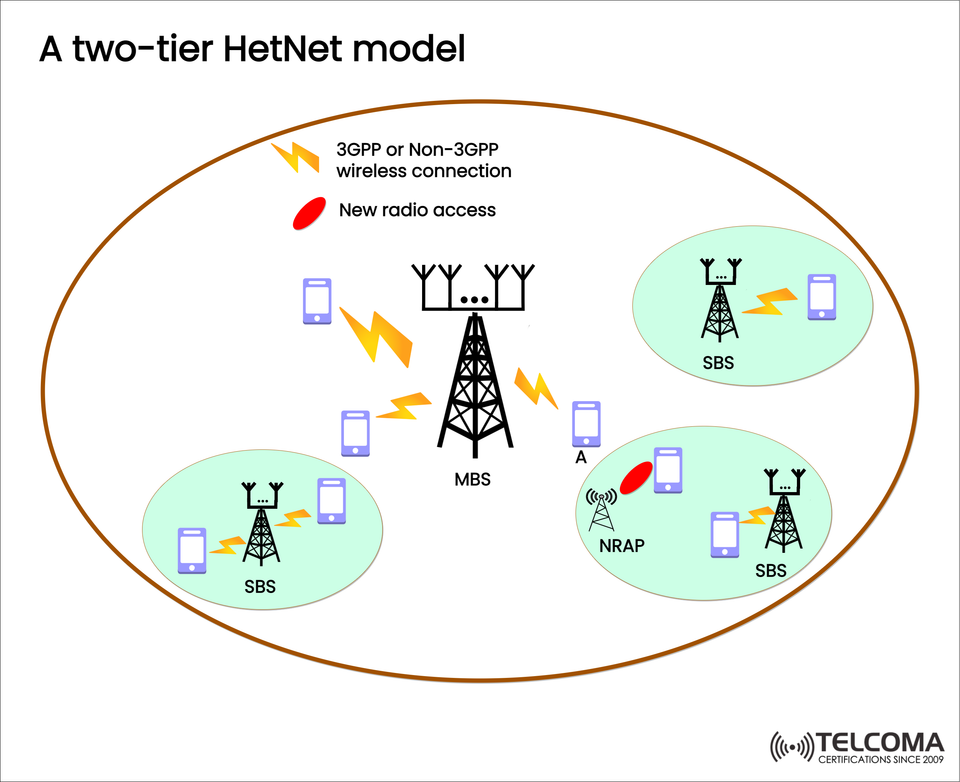
The diagram uploaded shows how a two-tier HetNet is structured, illustrating how different network components collaborate to create effective wireless connectivity. Let’s dive into it more deeply.
What’s a HetNet?
A Heterogeneous Network (HetNet) is a wireless network setup that employs a blend of various base station types, spectrum bands, and access technologies to boost performance. Unlike a traditional homogeneous network, where all cells are the same,
HetNets mix things up with:
Macro cells that offer wide coverage.
Small cells (SBS), like femtocells, picocells, or microcells, which enhance local capacity.
Non-3GPP access points (like Wi-Fi and NRAPs) that integrate unlicensed spectrum.
This mixed approach is particularly beneficial in urban hotspots, stadiums, and enterprise networks.
Elements of the Two-Tier HetNet Model
The image shared emphasizes several key parts of this model.
- Macro Base Station (MBS)
The MBS provides extensive coverage; it’s the backbone of the HetNet.
It functions in licensed spectrum and takes care of tasks like mobility management and interference coordination.
In the diagram, it spans the entire service area, ensuring basic connectivity.
- Small Base Stations (SBS)
SBSs are set up within the macrocell to boost coverage in densely populated areas.
They help increase network capacity, lessen the traffic load on the MBS, and enhance indoor coverage.
Positioned in smaller green zones in the diagram, SBSs connect directly to user devices.
- NRAP (New Radio Access Point)
NRAPs represent non-3GPP access technologies (like Wi-Fi or private 5G).
They provide offloading capabilities, letting devices switch from cellular to non-cellular links when it’s feasible.
This alleviates congestion on the MBS and SBS.
- 3GPP and Non-3GPP Wireless Connections
The diagram features orange lightning symbols that represent connections from either 3GPP or non-3GPP sources.
Devices can link up through standard cellular access (3GPP) or other technologies (like Wi-Fi or NRAPs).
- New Radio Access (NR)
Highlighted in red, NR connections showcase the role of 5G in HetNet configurations.
NR introduces greater bandwidth, ultra-low latency, and supports advanced applications like URLLC and massive IoT.
How the Two-Tier HetNet Model Functions
The heart of the two-tier HetNet is in how these layers work together:
Macro Coverage: The MBS guarantees large-area connectivity and acts as the mobility anchor.
Capacity Boost with SBS: SBSs handle high data demand, significantly improving throughput in crowded areas.
Traffic Offloading through NRAP: Non-3GPP access helps further alleviate congestion, providing more flexibility for users.
Seamless Handover: Users can move between macro, small, and non-3GPP cells without service interruptions, thanks to the integration with 5G core.
Advantages of the Two-Tier HetNet Model
Increased Capacity: SBSs manage local traffic, preventing overload on MBS.
Enhanced Coverage: SBSs address service gaps (like indoors).
Optimized Spectrum Usage: HetNets combine both licensed and unlicensed bands.
Better User Experience: Smooth transitions across various access technologies.
Scalability: It’s easy to add more SBSs in high-demand areas.
Challenges in HetNet Implementation
Even with the perks, HetNets bring their own set of challenges:
Interference Management: Overlapping macro and small cell coverage can create co-channel interference.
Backhaul Needs: SBSs and NRAPs need reliable backhaul to connect to the core network.
Mobility Management: Ensuring smooth transitions between different access technologies can be tricky.
Security Issues: Integrating non-3GPP access (like Wi-Fi) raises vulnerability concerns.
Strategies for HetNet Optimization
To tackle these issues, operators often use various optimization techniques:
Interference Coordination: More effective ICIC, eICIC, and CoMP methods.
Self-Organizing Networks (SON): Automating the setup and management of SBSs.
Load Balancing: Dynamically distributing traffic between macro and small cells.
Seamless Non-3GPP Access Integration: Utilizing the 5G core’s support for untrusted Wi-Fi or NRAP.
HetNets in Actual Scenarios
Urban Areas: SBSs found in malls, subway systems, or offices enhance the indoor 5G experience.
Smart Cities: HetNets support IoT devices across various access technologies.
Enterprise Networks: Private 5G NRAPs offer secure, high-speed connectivity for businesses.
Events & Venues: SBS clusters deal with heavy traffic loads from the macrocell.
Comparing HetNet to Traditional Networks
Feature | Traditional Network | Two-Tier HetNet
Coverage | Wide-area only | Wide + localized dense coverage
Capacity | Limited | Enhanced with SBS + NRAP
Spectrum Usage | Licensed only | Licensed + unlicensed (3GPP & Non)
Mobility Management | Simpler | Complex, multi-access handover
Scalability | Limited | Highly scalable with SBSs
The Future of HetNet in 5G and Beyond
The two-tier HetNet isn’t just a 5G enabler—it’s paving the way for 6G networks. With expectations for 6G to incorporate terahertz bands, AI-driven management, and extreme densification, the HetNet model will become even more complex and adaptable.
Upcoming improvements might include:
AI-enhanced interference forecasting.
Dynamic spectrum sharing across 3GPP and non-3GPP bands.
Closer integration with satellite networks.
Wrap-Up
The two-tier HetNet model is a fundamental part of today’s 5G architecture. By merging macro base stations, small cells, and new radio access points, it tackles the critical challenges of coverage and capacity.
For telecommunications professionals, grasping HetNets is essential for building networks capable of meeting growing data demands, diverse access technologies, and crucial services.
As we look toward 6G, HetNets are set to transform into even more sophisticated, multi-layered ecosystems—ensuring connectivity remains smooth, scalable, and secure.