
Understanding the VoNR Call Flow in 5G: Step-by-Step Breakdown of Voice over New Radio
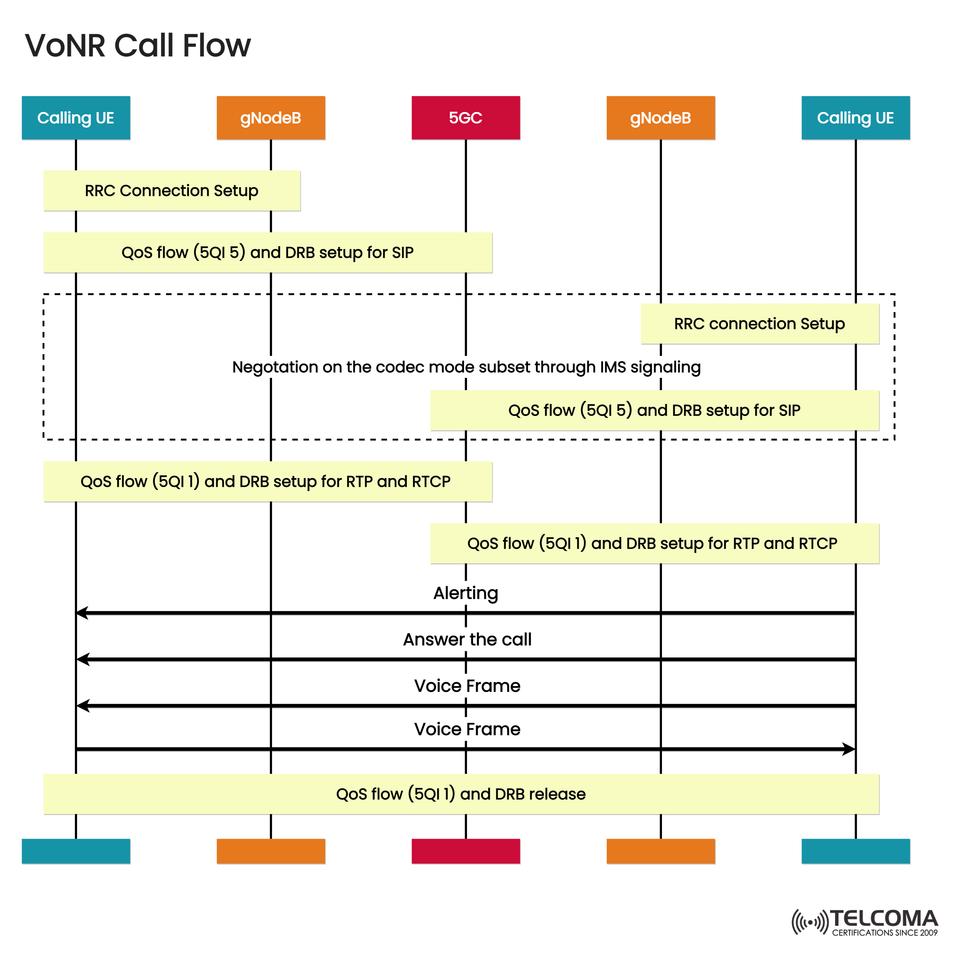

Voice over New Radio (Vo NR) Call Flow: Understanding How 5G Handles Voice Calls
With the arrival of 5G Standalone (SA) architecture, operators can now provide genuine 5G voice services directly over the 5G Core, known as Voice over New Radio (Vo NR).
Unlike Voice over LTE (Vo LTE), which relies on the EPC (Evolved Packet Core), VoNR operates entirely on the 5G Core (5GC). This means it brings lower latency, enhanced voice quality, and quicker call setup times.
In this post, we'll break down the entire Vo NR call flow — from setting up the initial connection to exchanging voice frames and finally releasing the session, all as depicted in the image above.
What is Vo NR (Voice over New Radio)?
Vo NR enables voice calls to be transmitted entirely over 5G NR, utilizing IP Multimedia Subsystem (IMS) signaling and QoS flows in the 5G Core.
Key Components Involved:
UE (User Equipment): The devices that make and receive calls using VoNR.
gNodeB (gNB): The 5G base station that manages radio access.
5GC (5G Core): The core network that takes care of session management and QoS control.
IMS (IP Multimedia Subsystem): Responsible for SIP signaling that manages call control and codec negotiation.
By integrating IMS with the 5G Core, Vo NR can handle voice and video calls natively over NR, without relying on LTE.
Overview of the Vo NR Call Flow
The image illustrates the Vo NR signaling sequence involving:
Calling UE
Serving g Node B
5G Core (5GC)
Receiving g Node B
Called UE
High-Level Call Flow Steps:
RRC Connection Setup
QoS Flow (5QI=5) for SIP Signaling
Codec Negotiation via IMS
QoS Flow (5QI=1) for RTP/RTCP Media
Alerting and Answering
Voice Frame Transmission
QoS Flow Release after Call End
Let’s dive deeper into these steps.
Step 1: RRC Connection Setup
The Radio Resource Control (RRC) connection setup is the initial step that establishes signaling between the UE and g NodeB.
The Calling UE starts the RRC Connection Setup Request.
The g NodeB replies with an RRC Setup message, enabling the UE to connect with the network.
This setup paves the way for further signaling messages.
The same process happens on the called UE side once paging and IMS signaling are initiated.
Step 2: QoS Flow (5QI=5) and DRB Setup for SIP
Once the RRC connection is in place, the network establishes a QoS flow for Session Initiation Protocol (SIP) signaling.
5QI (5G QoS Identifier) = 5 prioritizes IMS signaling traffic.
A Data Radio Bearer (DRB) is created to facilitate SIP messages between the UE and gNodeB.
This setup ensures SIP signaling — crucial for call setup and control — is transmitted reliably and quickly.
Step 3: Codec Negotiation via IMS Signaling
Once SIP connectivity is set, the UEs exchange SIP INVITE and 200 OK messages using the IMS core, which manages:
Codec negotiation (like AMR-WB, EVS)
Session parameters including RTP ports and transport protocols
Call setup authorization
This negotiation focuses on aligning the codec mode subset to guarantee both devices can handle the same voice encoding formats. This signaling crosses through the 5GC as represented by the dotted line in the diagram.
Step 4: QoS Flow (5QI=1) and DRB Setup for RTP and RTCP
After codec negotiation wraps up, the network sets up a new QoS flow for real-time voice traffic:
5QI = 1 is designated for conversational voice (highest priority).
Two bearers are established: * RTP (Real-Time Transport Protocol): Transfers voice packets. * RTCP (Real-Time Control Protocol): Oversees quality feedback and synchronization.
This setup occurs on both the calling and called sides, as shown in the image where each UE and gNodeB sets up DRBs for RTP/RTCP transmission.
Step 5: Alerting
Once the network prepares for voice transmission, the called UE sends an Alerting message back to the calling UE through SIP signaling (e.g., 180 Ringing).
This message signals that the call has reached its destination and the person on the other end is being alerted.
At this stage, the QoS flows for SIP and RTP/RTCP are active, but voice frames haven't started yet.
Step 6: Call Answer and Voice Transmission
When the called party picks up, an SIP 200 OK response confirms the call setup.
The calling UE responds with an SIP ACK message.
The RTP and RTCP streams begin exchanging voice frames back and forth through the established QoS flow (5QI=1).
The Voice Frame exchange stands for the actual media transfer across the NR user plane, ensuring:
Low latency
Guaranteed bitrate
High reliability
Each voice packet aligns with the corresponding DRB and its QoS settings, keeping up the quality even under heavy loads.
Step 7: Call Release and QoS Flow Deactivation
When either party ends the call:
An SIP BYE message is sent through IMS.
The network deactivates the QoS flow (5QI=1) and the linked DRB.
Control plane signaling for SIP (5QI=5) might linger a bit for call teardown confirmation.
Once released, the UE goes back to either an idle or connected state without any active voice flows.
Summary Table of Key QoS Flows
QoS Flow (5QI) Purpose Associated Traffic Type Direction
5QI = 5 SIP signaling IMS signaling messages Bi-directional
5QI = 1 Voice media RTP and RTCP streams Bi-directional
These standardized 5QIs ensure consistent Quality of Service (QoS) for various traffic types in VoNR.
Key Differences: Vo NR vs Vo LTE
Aspect Vo LTE Vo NR Core Network EPC (Evolved Packet Core)5GC (5G Core)Access TechnologyLTE5G NR (Standalone)Call Setup Time Higher (~1.5–2s)Lower (~0.8–1s)Voice Quality Good (AMR-WB)Enhanced (EVS codec)Handover Vo LTE-to-Vo LTE or CSFB Vo NR-to-Vo LTE or Vo NR intra-NR QoS Mechanism EPS Bearers QoS Flows and DRBs
Vo NR cuts out the need for LTE networks, providing pure 5G voice and better integration with services like video calling and AR/VR communication.
Advantages of VoNR
True 5G Experience: Native voice and data over 5G Core.
Lower Latency: Quicker call setup and improved responsiveness.
Enhanced Voice Quality: Utilizing EVS codecs for wideband and super-wideband audio.
Simplified Architecture: No fallback to LTE, minimizing signaling delays.
Unified QoS Framework: Smooth integration of voice, video, and data in the same 5G slice.
Troubleshooting Tip: Common VoNR Call Setup Failures
When troubleshooting call setup failures, engineers usually check:
IMS registration status and SIP message flow.
QoS flow setup for 5QI=5 (signaling).
RTP QoS flow establishment for 5QI=1.
Codec negotiation issues or missing DRBs.
RRC setup complications or gaps in NR coverage.
Capturing packets at gNB and 5GC interfaces (N2/N3) can help identify where things went wrong.
Conclusion
The VoNR Call Flow marks a significant leap forward for mobile voice, fully integrated within the 5G Standalone ecosystem.
By utilizing QoS flows, IMS signaling, and RTP-based transport, VoNR provides low-latency, high-quality voice calls without leaning on LTE.
For telecom engineers, grasping each part of this signaling process — from RRC setup to QoS flow release — is crucial for fine-tuning 5G voice deployment, resolving call setup issues, and ensuring a seamless user experience.
As networks shift to 5G SA, VoNR is set to be the default voice technology, wrapping up the transition to an all-IP 5G world where voice and data flow together on the same ultra-reliable network.