
Virtualized IMS Services on VMs: How Telecom Networks Leverage TECS for Elastic Scalability

IMS Services on VMs: The Future of Virtualized Telecom Infrastructure
As the telecom industry moves toward cloud-native architectures and virtualized environments, rolling out IP Multimedia Subsystem (IMS) on Virtual Machines (VMs) is becoming essential for achieving agility, scalability, and efficient operations.
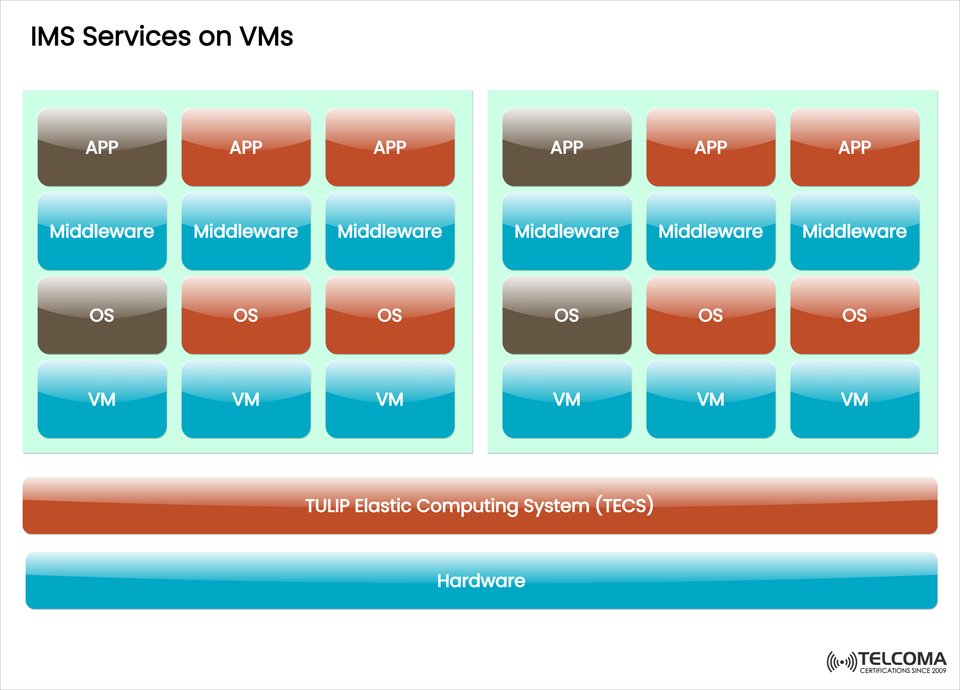
The image titled “IMS Services on VMs” shows a layered architecture that illustrates how various IMS components—like applications, middleware, and operating systems—are hosted on a virtualized infrastructure powered by the TULIP Elastic Computing System (TECS). This virtualization setup separates IMS network functions from the physical hardware, creating a adaptable and scalable environment that meets today's telecom needs.
Understanding IMS in the Telecom Ecosystem
The IP Multimedia Subsystem (IMS) is the backbone of today's telecommunication services, enabling offerings like VoLTE, VoWiFi, VoNR, and other IP-based multimedia applications. Traditionally, IMS functions were run on dedicated physical servers, which complicated scaling and maintenance efforts, making them pricey.
Thanks to virtualization, IMS services are now hosted on virtual machines. Each VM operates its own OS, middleware, and applications on top of shared hardware. This setup boosts resource efficiency and supports elastic computing, which lets operators allocate resources on the fly based on what’s happening in the network.
The Layered Architecture of IMS Services on VMs
The diagram illustrates a five-layer virtualized IMS architecture:
Application Layer (APP)
Middleware Layer
Operating System (OS) Layer
Virtual Machine (VM) Layer
TULIP Elastic Computing System (TECS)
Hardware Layer
Let's break down each of these layers and understand their roles in delivering strong, scalable IMS services.
Application Layer (APP): Delivering IMS Core Services
At the top of the architecture is the Application Layer, which carries the IMS core network functions and applications.
This includes:
CSCF (Call Session Control Function) — Manages SIP signaling and session control.
HSS (Home Subscriber Server) — Handles user profiles and authentication.
TAS (Telephony Application Server) — Offers voice and multimedia services.
MGCF (Media Gateway Control Function) — Manages media gateway resources.
Each APP runs independently within its VM, which means services are isolated and resilient. If one virtual instance goes down, the others can keep running without a hitch. This modular approach fits well with cloud-native principles, allowing for service agility and continuous integration/continuous deployment (CI/CD).
Middleware Layer: Enabling Communication Between Apps and OS
The Middleware Layer acts as a communication link between the applications and the operating systems. It provides key runtime services like:
Database connectivity and caching
Message queuing and session management
Service orchestration and API management
Middleware is crucial for making sure IMS applications work well in a distributed environment, managing signaling and media control without relying on the physical hardware. It also boosts interoperability among different vendors' network components, which is vital in telecom settings.
Operating System Layer: Providing Platform Stability
Each virtual machine runs its own Operating System (OS), typically a Linux-based environment that's optimized for telecom performance.
The OS layer is responsible for:
Managing resources (CPU, memory, I/O scheduling)
Keeping processes isolated for better security
Supporting real-time communication protocols (SIP, RTP, RTCP)
By having separate OS instances for each VM, operators can customize configurations for different IMS roles while ensuring strong security isolation between services.
Virtual Machine Layer (VM): Enabling Multi-Tenancy and Scalability
The VM layer is the virtualization environment where each IMS function runs as a guest instance.
Some key benefits of the VM layer include:
Multi-tenancy: Multiple IMS functions can share the same hardware.
Dynamic Scaling: VMs can be cloned, expanded, or moved as network needs change.
Fault Recovery: If a VM crashes, services can quickly restart on another host without any downtime.
This virtualization approach allows IMS services to scale effectively while ensuring carrier-grade reliability, which is critical for telecom networks.
TULIP Elastic Computing System (TECS): The Virtualization Backbone
The TULIP Elastic Computing System (TECS) sits underneath the VMs and serves as the virtualization and orchestration layer. TECS is the cloud infrastructure platform that dynamically manages compute, storage, and networking resources across the hardware.
Functions of TECS:
VM Orchestration: Automates deployment, scaling, and migration of VMs.
Resource Pooling: Efficiently allocates CPU, memory, and storage resources.
Elastic Computing: Adjusts resources automatically based on real-time workloads.
High Availability (HA): Detects failures and shifts workloads to healthy nodes.
Security Enforcement: Implements isolation and access control at the hypervisor level.
In brief, TECS offers the flexibility and automation needed to run IMS workloads efficiently, ensuring optimized performance, resilience, and energy efficiency in virtualized telecom setups.
Hardware Layer: The Physical Foundation
At the bottom is the hardware layer, made up of physical servers, network interfaces, and storage devices, forming the backbone of the IMS hosting environment.
This hardware infrastructure supports:
High-speed data processing for SIP signaling and media handling
Carrier-grade reliability and redundancy
Compatibility with NFV standards for open and interoperable deployments
It's built to handle the rigorous performance needs of IMS workloads while also providing energy-efficient and scalable compute power.
Advantages of Deploying IMS Services on Virtual Machines
Moving IMS to VMs offers transformative advantages for telecom operators and service providers:
Category Benefit Description Scalability Elastic resource allocation VMs scale dynamically with user demand. Cost Efficiency Reduced CAPEX and OPEX Shared hardware lowers investment and operational costs. Resilience High availability and recovery Services can migrate automatically if faults occur. Flexibility Multi-vendor interoperability Open architecture allows integration with various vendors. Speed of Deployment Rapid provisioning New IMS instances can be up and running in minutes, not weeks. Security Isolation per VM Logical separation prevents cross-function interference.
This setup aligns with NFV (Network Function Virtualization) and cloud-native frameworks, getting operators ready for a smooth transition toward 5G and beyond.
Why TECS is Critical for Telecom Virtualization
The TULIP Elastic Computing System (TECS) is not just a hypervisor; it’s a complete cloud management platform. For telecom operators, TECS makes managing thousands of VMs running real-time IMS workloads much simpler.
Key TECS Advantages:
Automation: Orchestrates provisioning and scaling.
Reliability: Keeps uptime with redundancy and fault recovery.
Performance Monitoring: Tracks VM health and network throughput.
Open Integration: Supports APIs for compatibility with OSS/BSS systems.
By using TECS, telecom providers can tap into cloud-native agility without sacrificing the reliability needed in telecom networks.
Conclusion: The Future of IMS Virtualization
The shift toward IMS services on virtual machines represents a significant evolution in telecom infrastructure. It equips operators with the scalability, flexibility, and efficiency required to meet the fast-changing demands of 5G, VoNR, and IoT-driven ecosystems.
The layered architecture—from applications all the way down to hardware—shows how virtualization and TECS work together to optimize network resources while ensuring continuous service.
In essence, deploying IMS on VMs isn't just a technical upgrade—it's a strategic move towards a software-defined, future-proof telecom network that delivers enhanced service agility and cost-effectiveness.