
2D Planar Uniformly Spaced Antenna Array Model Explained: Foundation of 5G Beamforming

Getting to Grips with the 2D Planar Uniformly Spaced Antenna Array Model in 5G
The shift in wireless communication—from 4G LTE to 5G NR and what lies ahead—relies heavily on one key development: advanced antenna array design. Among these, the 2D Planar Uniformly Spaced Antenna Array (UPA) model is a standout, playing a vital role in massive MIMO and beamforming. Together, these technologies deliver greater capacity, wider coverage, and better reliability.
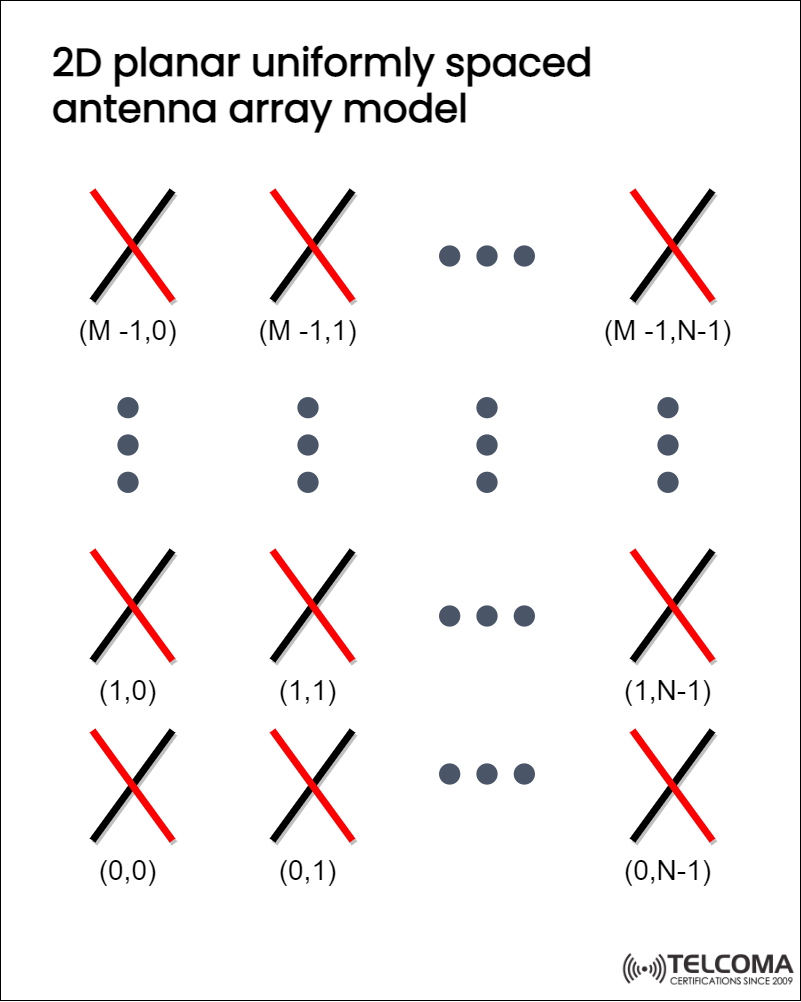
The image up top from Tel coma gives a clear look at how a 2D planar antenna array is structured, with antennas laid out in a rectangular grid that’s spaced evenly along both the x-axis and y-axis. This setup makes it possible to control beam directions in both azimuth and elevation, which is crucial for the next-gen wireless systems.
What Is a 2D Planar Uniformly Spaced Antenna Array?
A 2D planar uniformly spaced antenna array is basically a grid of antennas arranged in two dimensions, typically forming a rectangular or square shape.
Each antenna in the array is spaced apart by a consistent distance in both the horizontal (x) and vertical (y) directions—usually about half the wavelength (λ/2) of the carrier frequency.
Mathematical Representation
If we let:
MMM = number of elements along the x-axis
NNN = number of elements along the y-axis
Then the coordinates of each antenna element are given by:
(m,n) where m = 0, 1, 2,...,M−1; n = 0, 1, 2,...,N−1
This matches what’s shown in the image—each antenna’s position is defined by its unique (m, n) index.
- Structure and Visualization
The image shows a uniformly spaced grid, with each cross (X) representing an antenna.
The array begins at (0,0) (bottom-left corner).
It stretches to (M–1, N–1) (top-right corner).
The uniform spacing helps ensure consistent phase differences for effective beam formation.
In the illustration, some antennas are highlighted to emphasize the 2D planar structure—this model serves as a foundation for modern massive MIMO arrays used in 5G base stations and devices.
How the 2D Planar Array Works
Unlike a 1D linear array that can only steer beams in one direction (usually horizontal), a 2D planar array can control beams in two dimensions—both azimuth and elevation.
This 2D steering allows for 3D beamforming, enabling the system to:
Precisely target users in both horizontal and vertical spaces.
Minimize interference from unwanted angles.
Enhance coverage in crowded urban settings or multi-story buildings.
Beamforming Principle
The core concept behind beamforming is constructive and destructive interference. By fine-tuning the phase and amplitude of signals sent to each antenna element, the array boosts signals in desired directions while muting them elsewhere.
For a planar array, we express the array factor (AF) as follows:
AF(θ,ϕ)=∑m=0M−1∑n=0N−1ejkd(msinθcosϕ+nsinθsinϕ)
Where:
θ = elevation angle
ϕ = azimuth angle
k=2π/λ (wave number)
d = antenna spacing
This formula helps quantify how the array combines signals from all elements to shape its radiation pattern.
Advantages of a 2D Planar Uniformly Spaced Array
a. 3D Beamforming Ability
Can steer beams both in azimuth and elevation.
Essential for advanced 5G and 6G systems that support multi-user MIMO.
b. Compact Design
Works well with mmWave frequencies, where smaller wavelengths allow hundreds of antennas to fit into tight spaces.
c. High Directivity and Gain
Boosts the Signal-to-Noise Ratio (SNR) by directing energy exactly at intended receivers.
d. Reduced Interference
By directing nulls toward interference sources, it enhances spectral efficiency.
e. Scalability
Can be expanded by simply increasing M and N for larger arrays, all while keeping the spacing the same.
- Real-World Applications
- 5G Base Stations
Massive MIMO base stations leverage 2D planar arrays to direct beams towards several users at once, enabling multi-user beamforming and spatial multiplexing.
- mmWave Communications
At higher frequencies (like 28 GHz, 39 GHz), planar arrays are crucial due to their shorter wavelengths, which allow many antenna elements in compact setups.
- Satellite and Radar Systems
Utilized for electronically steered arrays (ESA), enabling quick scanning of vast areas without needing mechanical movement.
- UAVs and Autonomous Vehicles
Planar arrays maintain directional communication links in constantly shifting 3D environments.
- Comparison: 1D vs 2D Antenna Arrays
Feature1D Linear Array2D Planar Array Structure Elements aligned in one line Elements arranged in rows & columnsBeamforming1D (horizontal/vertical)2D (both azimuth and elevation)Coverage Control Limited Full 3D coverage Applications Simple MIMO systems, narrow beam control Massive MIMO, 5G beamforming, radar Complexity Lower Higher (requires phase control in 2D)
The table really illustrates why 2D arrays are so crucial in 5G NR—they provide full spatial control and improve multi-user performance.
- Design Considerations
When setting up a 2D planar array, there are several design aspects that can affect its performance:
- Element Spacing (d)
Generally set at d=λ/2 to avoid grating lobes.
Ensures optimal constructive interference at desired beam angles.
- Array Geometry
Square arrays (M=N) provide symmetry and simpler control.
Rectangular arrays (M≠N) help tailor beamwidth and gain.
- Excitation Amplitude and Phase
Uniform excitation leads to simpler beams but higher sidelobes.
Tapered (non-uniform) excitation cuts sidelobes, boosting performance.
- Mutual Coupling
Antennas placed too close can interfere with one another, so careful design and calibration are necessary.
- Calibration and Control
Digital beamforming systems need to adjust phases on the fly using DSP algorithms or AI optimization.
- Role in 5G NR and Beyond
Massive MIMO Implementation
In 5G, base stations often use arrays with 64, 128, or 256 antenna elements. Each contributes to spatial multiplexing, allowing the system to serve multiple users simultaneously on the same time-frequency resource.
Beam Management
Planar arrays facilitate precise beam tracking and switching, which is critical for mmWave frequencies, where narrow beams are essential to counter high path loss.
Energy Efficiency
By focusing energy only where it’s needed, planar arrays enhance power efficiency and broaden network coverage.
Path Toward 6G
Future 6G systems are set to take these principles further with reconfigurable intelligent surfaces (RIS), where thousands of small antennas dynamically shape the radio environment.
- Visualization Summary (Image Explanation)
The Telcoma diagram gives a straightforward view of the 2D planar array:
Every antenna element is indexed by coordinates (m, n).
Rows and columns create a uniform grid, ensuring equal phase progress.
The red-black “X” markers represent antenna elements that can send and receive signals.
The uniform spacing is crucial for consistent beam patterns and predictable gain performance.
Conclusion
The 2D Planar Uniformly Spaced Antenna Array Model is key to 5G beamforming and massive MIMO. By enabling precise 3D beam control, it guarantees reliable, high-capacity, and energy-efficient wireless communication.
This model's adaptability makes it essential in everything from mmWave networks to autonomous systems, and as we advance toward 6G intelligent communication systems, it will continue to play a significant role. With the ongoing evolution of wireless technologies, the planar array’s ability to dynamically shape beams in both horizontal and vertical planes will be central to creating faster, smarter, and more connected networks.