
Understanding Resource Fragmentation in 5G: Mixing Mini-slot and Normal-slot Transmissions
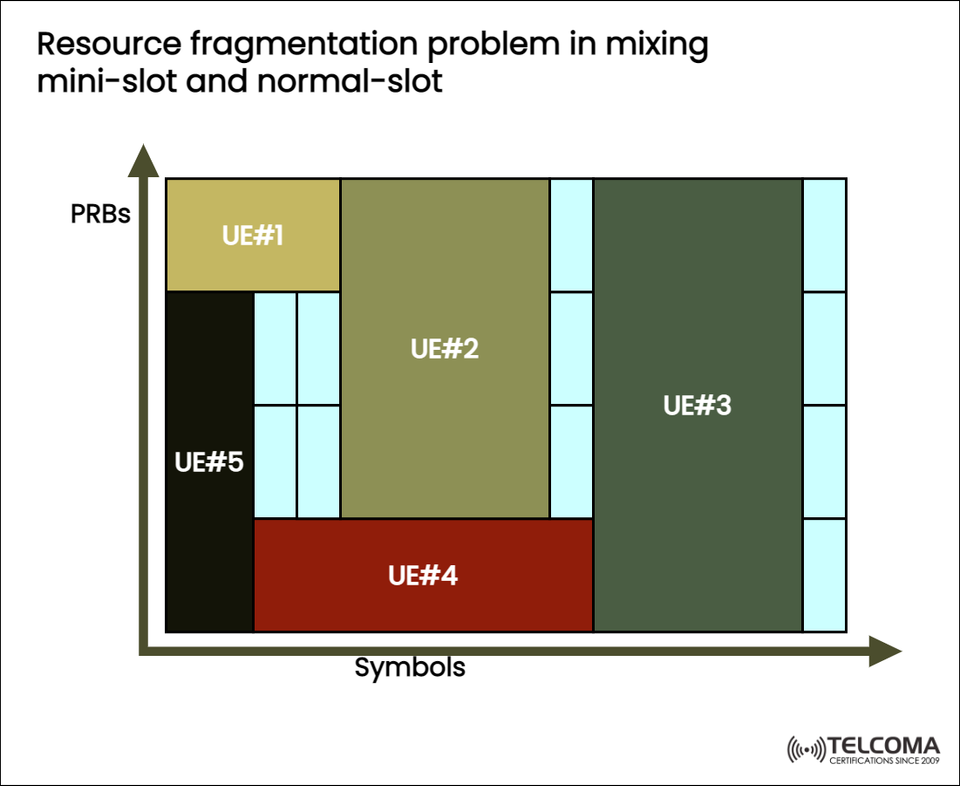

Resource Fragmentation Issues in Mixing Mini-slot and Normal-slot in 5G NR
As 5G New Radio (NR) continues to develop, flexibility and low latency have become key focus points. One of the innovations contributing to this flexibility is mini-slot transmissions, which allow for data to be sent in shorter time frames compared to the standard full slots.
However, as illustrated in the image attached, mixing mini-slot and normal-slot transmissions can create a significant network hurdle known as resource fragmentation. This problem can reduce spectral efficiency, lead to wasted resources, and complicate scheduling at the base station (gNB).
In this article, we’ll dive into what resource fragmentation is, why it happens when mini-slots and normal slots are mixed, and how 5G NR addresses this issue to sustain high performance.
Understanding the Basics: Slots and Mini-slots in 5G NR
Before we get into the fragmentation issue, it’s important to grasp how slots and mini-slots function in 5G NR.
- Normal Slot
A normal slot in 5G usually has 14 OFDM symbols per subframe (1ms long).
This is typically used for regular data transfers and control signaling.
Normal slots are great for ensuring maximum throughput and predictable scheduling, which works well for services that aren't particularly sensitive to latency.
- Mini-slot
A mini-slot includes 2, 4, or 7 OFDM symbols, making it much shorter than a normal slot.
It facilitates immediate transmission without waiting for the next slot to start, significantly cutting down on latency.
Mini-slots are crucial for Ultra-Reliable Low Latency Communication (URLLC) and real-time applications such as autonomous vehicles and factory automation.
Slot Composition Summary
Slot Type | OFDM Symbols | Transmission Time | Primary Use Case
Normal Slot | 14 symbols | 1 ms | eMBB (enhanced mobile broadband), mMTC
Mini-slot | 2, 4, or 7 symbols | <1 ms | URLLC, low-latency data, quick uplink feedback
What is Resource Fragmentation in 5G NR?
Resource fragmentation involves the inefficient use of radio resources when available Physical Resource Blocks (PRBs) and symbols can’t be allocated continuously to users.
In 5G, the gNB scheduler dynamically assigns time-frequency resources to User Equipment (UEs). Ideally, resources should be allocated continuously to optimize efficiency. However, when mini-slots and normal slots, which have different lengths, overlap in time or frequency, fragmentation happens.
As a result, some PRBs are left unused or only partially used, creating gaps in the resource grid, as illustrated in the uploaded image.
Understanding the Image: Resource Fragmentation Visualization
The image visually represents how mixing mini-slot and normal-slot transmissions can lead to resource fragmentation:
The x-axis (Symbols) shows time (number of OFDM symbols).
The y-axis (PRBs) indicates frequency resources allocated across users.
Each colored block represents a User Equipment (UE) assigned specific resources.
Breakdown of the Scenario
UE#1, UE#2, UE#3, UE#4, and UE#5 receive resources with different slot durations.
Some UEs operate with normal slots (14 symbols), while others utilize mini-slots (2-7 symbols).
The light blue areas stand for unused or underutilized PRBs due to fragmentation.
Observation
The visual shows that:
When a mini-slot transmission (like UE#5) overlaps with a normal-slot transmission (such as UE#2 or UE#3), it disrupts the continuity of resources available.
These fragmented resources can’t be reused easily until the ongoing normal-slot transmission is complete.
As a result, overall spectral efficiency declines, despite having PRBs available in the same time frame.
Why Fragmentation Happens When Mixing Mini-slot and Normal-slot
Fragmentation primarily stems from time-frequency resource misalignment. Let’s look at the main causes:
- Time-domain Misalignment
Mini-slots can begin at any OFDM symbol boundary, but normal slots only start at fixed slot boundaries. If a mini-slot starts amid an ongoing normal slot, it interrupts the potential for continuous scheduling.
- Frequency-domain Partitioning
Different UEs may occupy separate frequency domains, but when time durations vary (mini-slot versus normal slot), the scheduler has a tough time assigning adjacent PRBs efficiently.
- Scheduling Conflicts
The gNB scheduler has to handle both low-latency (mini-slot) and high-throughput (normal-slot) traffic. In doing so, small unused gaps often remain that can’t fit another full transmission, leading to resource wastage.
- URLLC Preemption
URLLC services frequently preempt ongoing eMBB transmissions using mini-slots. This preemption can disrupt normal-slot data, causing gaps that reduce overall throughput.
Impact of Resource Fragmentation on Network Performance
The ramifications of resource fragmentation go beyond mere inefficiency. They influence various layers of network performance:
- Reduced Spectral Efficiency
Fragmented PRBs stay unused even though they’re physically available.
This results in lower throughput and underutilized spectrum, negatively affecting eMBB users.
- Increased Scheduling Complexity
The gNB scheduler constantly needs to re-optimize allocations to prevent idle gaps.
This makes scheduling more computationally intensive, requiring sophisticated algorithms.
- QoS Degradation
Some users might deal with delays or dropped packets if their transmissions can’t be optimally placed within fragmented resources.
URLLC’s preemption may adversely impact eMBB Quality of Service (QoS).
- Power Inefficiency
Transmitters might work at partial utilization, leading to inefficient power consumption and decreased battery life for UEs.
Strategies to Mitigate Resource Fragmentation
To keep high spectral efficiency while catering to diverse 5G applications, NR employs several strategies:
- Dynamic Scheduling and Preemption Indication
5G NR offers dynamic scheduling where gNBs can quickly reallocate resources. A preemption indication alerts affected UEs that parts of their ongoing transmissions have been interrupted, allowing for intelligent retransmission later on.
- Flexible Slot Configuration
The NR frame structure accommodates mini-slots of varying lengths (2, 4, or 7 symbols), giving the scheduler more flexibility to fill available gaps effectively.
- Multi-User Scheduling
By intelligently grouping UEs with similar slot durations, the scheduler can cut down on time-domain overlaps, reducing fragmentation.
- Frequency-domain Multiplexing
When time alignment isn’t possible, gNBs can separate transmissions in the frequency domain, assigning mini-slot users and normal-slot users to different sets of PRBs.
- Hybrid Automatic Repeat Request (HARQ) Optimization
HARQ feedback mechanisms are refined to manage preempted transmissions effectively, minimizing retransmission delays.
Illustrative Example: Fragmentation in Action
Picture a base station dealing with five UEs:
UE#1–UE#3: Use normal slots for eMBB data.
UE#4–UE#5: Send URLLC packets with mini-slots.
When UE#5 transmits a mini-slot in the midst of UE#2’s ongoing normal-slot, UE#2’s data can no longer use that part of the symbol grid. Even after the mini-slot wraps up, the leftover symbols within the same slot are usually too short to accommodate another full data block, creating fragmentation gaps.
Future Outlook: Smarter Scheduling in 5G and Beyond
As 5G Advanced (3GPP Release 18+) develops, better scheduling and resource management techniques are being introduced to lessen fragmentation.
Key innovations include:
AI-driven scheduling to dynamically predict resource demand.
Time-frequency resource pooling for more flexible use.
Cross-slot channel estimation to better synchronize mini-slot and normal-slot coexistence.
These advancements aim to ensure that URLLC, eMBB, and mMTC services can smoothly coexist without compromising network efficiency.
Conclusion
The uploaded image may highlight one of the subtle yet vital challenges in 5G NR – resource fragmentation that arises from mixing mini-slot and normal-slot transmissions.
While mini-slots allow for ultra-low-latency communication, their coexistence with normal slots can lead to underutilized PRBs and scheduling inefficiencies. However, through dynamic scheduling, flexible frame structures, and smart resource allocation, 5G networks can minimize fragmentation and maintain optimal performance.
As networks transition into 5G Advanced and 6G, efficiently balancing latency-sensitive and high-throughput traffic will continue to be a crucial aspect of next-generation radio resource management.